iOutdoors Blog, Conservation, Press Release, Sport Fishing
What is a Boga Grip?
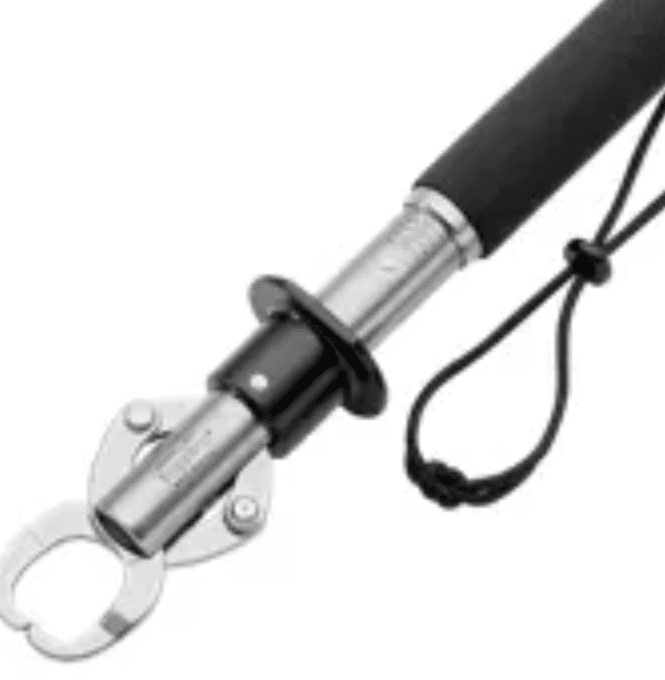
The Boga Grip is a landing, handling and weighing tool used in both freshwater and saltwater fishing. Designed for anglers who practice catch and release. It can grip a fish by encircling its lower jawbone. So that despite wiggling, spinning, and flopping, it can’t getaway. However, the Boga Grip does not rub off the protective layer of the fish or harm its scales or flesh in any way. It is then a hassle-free way of keeping tabs on your trophy-worthy catch. Allowing and taking that souvenir photo before releasing the fish back into the water.
This patented tool is so easy to use and can be operated with the use of one hand only. Not only can it be used on most species of fish, but its stainless steel body is also built for durability being rust and salt-water resistant. Due to the extended handle, anglers using the Boga Grip could land a fish at a safe distance. It also has a rubberized grip so that users will always maintain a firm grasp. The device is also compact enough to be conveniently used by surf or wade fishermen.
The Boga Grip’s precision scales are not only durable but are also very accurate as certified by the IGFA (International Game Fish Association). It can handle fish double its capacity, and comes in three models:
- 315 Model: This model is 9 inches in length and 9 ounces in weight, and can weigh fish up to 15 pounds.
- 130 Model: This model is 10 ¾ inches in length and 1 pound in weight, and can weigh fish up to 30 pounds.
- 260 Model: This model is 15 inches in length and 1.5 pounds in weight, and can weigh fish up to 60 pounds.
ABOUT US
The BogaGrip is the original time tested – saltwater tough fish landing, handling, and weighing tool. It is designed for the sport fisherman who practices catch and release. The BogaGrip’s Accurate and durable scales have been used to certify the weight of over 3,400 IGFA World Record Fish. The BogaGrip has been the top IGFA scale for the last several years.
15, 30, and 60-pound models available.
iOutdoors Blog, Conservation, Press Release
Florida Red Tide
When you think of Florida, you think of beautiful beaches and an abundance of wildlife and exceptional fishing. Every year, the Southwest Coast of Florida gets affected by naturally occurring algae known as Red Tide. The Florida Red Tide happens to be one of the strongest yet this year. Even though this may be the case, Florida loves its natural ecosystems and fisheries greatly and is endlessly working to bring balance back to our local communities.
Nature will always strike, whether it is algae blooms, hurricanes or other natural stressors that cause people to unite. One of the blessing about Florida is that we always come together to make an effort to maintain and improve our communities and local ecosystems. Floridians will not be affected for a long period of time when we set our mind together to find a solution to our problems we may face every year.
Governor Rick Scott, a larger supporter in the outdoor industry, local communities, tourism and our beautiful beaches has declared a state of emergency to help those counties affected by these toxic algae. Our government is doing everything it can to revive our natural fisheries and ecosystems that have been struck by the Florida Red Tide. They want those travelers and visitors to enjoy all that Florida has to offer.
Governor Scott will “continue taking an aggressive approach by using all available resources to help our local communities as well as provide significant funding and resources to communities experiencing red tide so we can combat its terrible impacts.” – flgov.com There is nothing that our local communities and governments won’t do in order to clean our beaches, improve ecological balance and bring our visitors safely back to the beaches they once enjoyed.
Florida Fishing whether freshwater or saltwater is a staple outdoor activity for locals and visitors. It is essential to regain balance to our fisheries along with initiate a plan to find solutions for the future. Every community member, government official and tourism board member are coming together collectively to find an effective solution.
Visit Florida, the official site for state travel, tourism and vacation planning has been order by Governor Scott to set a plan for Tourism Recovery. They created a “$500,000 emergency grant program to assist local tourism development boards in counties affected by the naturally-occurring red tide, which include Collier, Lee, Charlottee, Sarasota, Manatee, Hillsborough and Pinellas counties.” It will be essential to bring awareness to the recovery of our communities and beaches once the Florida Red Tide has subsided. Recovery is right around the corner and we will be glad to have our communities back up and running with safe waters and lively ecosystems especially in Cities like Fort Myers, Tampa, Sarasota and Naples.
We are looking forward to seeing you back here in Florida getting to enjoy this breath-taking travel destination as soon as possible. Experiencing all that Florida has to offer especially outdoor activities is the most important part of visiting Florida. Everyone here in Florida is doing everything we can to get this wonderful place to our tourist standards as well as our local communities!
If you are planning your next vacation to Southwest Florida and want to experience the incredible fishing, don’t hesitate to reach out. We are here to answer any questions you may have about conditions and fishing conditions. Uncover all that Florida has to offer with great outdoor activities.
[fusion_builder_row_inner][fusion_builder_column_inner type=”1_2″ layout=”1_2″ last=”no” min_height=”” hover_type=”none” link=”” border_position=”all”][fusion_button link=”https://ioutdoor.com/fishing/florida/naples/” text_transform=”uppercase” title=”Plan Your Next Outdoor Vacation” target=”_self” link_attributes=”” alignment=”center” modal=”” hide_on_mobile=”small-visibility,medium-visibility,large-visibility” class=”” id=”” color=”blue” button_gradient_top_color=”” button_gradient_bottom_color=”” button_gradient_top_color_hover=”” button_gradient_bottom_color_hover=”” accent_color=”green” accent_hover_color=”” type=”” bevel_color=”” border_width=”3px” size=”small” stretch=”yes” shape=”pill” icon=”fa-ticket-alt fas” icon_position=”left” icon_divider=”no” animation_type=”flash” animation_direction=”left” animation_speed=”0.3″ animation_offset=”top-mid-of-view”]PLAN YOUR NEXT FISHING VACATION[/fusion_button]
Your Adventure Starts Today while Visiting Florida.
Don’t forget to follow us on Facebook, YouTube, Twitter and Instagram.

iOutdoors Blog, Conservation
Free Florida Fishing Licenses
Governor Rick Scott announces that all Florida’s First Responders and law enforcement officers will receive free Florida fishing licenses for their efforts during and after Hurricane Irma. The gift of fishing can help further in the recovery efforts and stress levels of all the responders. Discover some new waters in Miami or in Fort Lauderdale.
SANFORD, Fla. – Today, Governor Rick Scott announced that Florida’s law enforcement officers and first responders will be able to enjoy license-free freshwater and saltwater fishing beginning today through June 30, 2018. This is in recognition of their lifesaving work preparing and responding to Hurricane Irma. The Florida Fish and Wildlife Conservation Commission (FWC) will accept official first responder identification in lieu of a Florida fishing license during this period. The Florida Department of Environmental Protection (DEP) is also offering free day-passes to Florida State Parks that can be used on an unlimited basis until October 2018 for all law enforcement officers, first responders and utility workers.
Governor Scott said, “Before and after Hurricane Irma, Florida’s brave law enforcement officers and first responders have been tirelessly working around the clock to meet the needs of our families and communities. Even as their own families were evacuating or working to begin the recovery process, they have been putting their own lives on the line to keep our state safe. We owe these brave heroes a debt of gratitude, and I am proud to announce this license-free fishing opportunity as a gesture of appreciation and recognition for their service to our state.”
Brian Yablonski, FWC Chairman, said, “These true heroes of hurricane response efforts will be able to enjoy Florida’s world-class freshwater and saltwater fishing opportunities without buying a fishing license. It is our hope this small token of appreciation will give these dedicated men and women an opportunity to get a break from stressful recovery work so they can relax and enjoy good times fishing with family and friends.”
Source: flgov.com

iOutdoors Blog, Conservation, Everglades Fishing, Islamorada Fishing
BY SUE COCKING
SCOCKING@MIAMIHERALD.COM
Working with skiff guides, anglers and conservation groups, Everglades National Park has revised its draft general management plan to provide more access for boating, fishing and paddling in Florida Bay than what it proposed a year ago.
The new “preferred alternative” for long-term management of park waters was generally well-received at a meeting of park officials and fishing guides Friday in Islamorada.
“I think this plan is going to work for everyone,” said veteran Islamorada light-tackle guide captain Dave Denkert. “We’ve got to go out of our way to fish certain areas. But I think it’s going to benefit all of our kids and our kids’ kids.”
Guides and anglers were upset last year when officials announced they favored designating about a third of park waters as pole/troll zones, which require boaters to use push poles or electric trolling motors instead of outboards. Fishermen said the zones were too large and lacked transit corridors to get in and out in case of bad weather or other emergencies. They demanded a compromise, and apparently got it after conducting numerous meetings and on-water field trips with park personnel over the past year for a New Everglades National Park Proposal.
The revised plan reduces the proposed pole/troll zones by about 29,000 acres, adding corridors where boaters may use their engines. It adds two pole/troll/idle zones totaling more than 24,500 acres — one on the westernmost side of the bay around Sandy Key and First National Bank and a smaller area in the central bay around the Samphire Keys. Boaters in those zones would be required to use push poles or electric motors, unless the vessel could idle on its outboard without disturbing the bottom while Saltwater Fishing in Florida.
The new proposal removes Long Sound as a paddle-only zone and allows on-plane access with an idle-speed buffer. It opens Joe Bay/Snag Bay — closed to all public access since 1980 as a crocodile sanctuary — to paddlecraft but not motorboats.
“We’re trying to protect the resource but provide reasonable and appropriate access, and that’s what you have helped us with,” park superintendent Dan Kimball told guides at Friday’s meeting. “We’ve really listened to you. We’ve really incorporated that a lot in our plan.”
The plan retains some of its original proposals — a mandatory education and permitting program for boaters operating in park waters and establishment of a citizen advisory committee to help park officials with adaptive management as the plan is implemented. Captain Tad Burke of the Florida Keys Fishing Guides Association said members of his group should have designated seats on that panel for a New Everglades National Park Proposal.
Guides and anglers at the meeting seemed pretty satisfied with the new preferred alternative except for a few suggested tweaks. But they told Kimball they are concerned about his retirement this month coming just as the plan is making its way through the National Park Service review process for final adoption later this year. Kimball will be replaced by acting superintendent Shawn Benge, now deputy director of the southeast region of the park service, on March 21. But Kimball reassured fishermen he’s got their backs.
Said Kimball: “I don’t see anybody coming in doing a 180 on this plan.”
Read more here: http://www.miamiherald.com/2014/03/02/3968183/new-everglades-national-park-proposal.html#storylink=cpy

iOutdoors Blog, Conservation
Catching a trophy fish and watching it swim away is one of the most rewarding feelings for an angler.
Knowing it can live another day to reproduce and possibly provide another angler with the same feeling can outweigh taking a fish home for the dinner table.
Don’t get me wrong. I love to eat certain fish, but I understand the need for balance when it comes to keeping what I catch.
Groups like the Coastal Conservation Association (CCA) are dedicated to the balance of the fishing resource for long-term prosperity. The stated purpose of CCA is to advise and educate the public on conservation of marine resources. The objective of CCA is to conserve, promote and enhance the present and future availability of these coastal resources for the benefit and enjoyment of the general public.
The CCA began in 1977 “after drastic commercial over fishing along the Texas coast decimated redfish and speckled trout populations,” the JoinCCA.org website says. “Fourteen concerned recreational anglers created the Gulf Coast Conservation Association to combat commercial overfishing.”
In 1985, Florida became the fifth state chapter in the CCA.
Since then, the CCA has been in favor of protecting fishing resources. In 1994, the CCA led the push for the net ban that was voted and approved by a 72-percent margin. As the net ban re-emerged into the spotlight this year after a controversial ruling in Tallahassee, the CCA was there to get the ruling upheld once again for Coastal conservation activities.
“Without the CCA, recreational fishing in Florida would be very poor,” CCA Executive Director Brian Gorski said. “Getting the nets out of the water did wonders for inshore and offshore fisheries. It helped bait and mullet stocks come back while also reducing the amount of waste and kill of premier game fish like snook, trout and redfish.”
This past Thursday, I was lucky enough to attend the 15th annual Manatee County CCA Chapter Banquet & Auction presented by Conley Buick GMC at the Bradenton Area Convention Center. I say lucky because the event sold out 475 tickets nearly two weeks in advance.
The event brought together many like-minded anglers in Florida to raise money for the CCA. “All money raised in Florida stays in Florida to protect recreational anglers’ rights and to protect the resource. We would spend every last dime fighting the net ban, but it goes far beyond that. We help fund scientific studies, marine science scholarships, build artificial reefs, create finfish hatchers, monitor water quality, support local law enforcement, establish game fish status for recreational species and of course work to prohibit destructive commercial gear,” Gorski said.
It was a night filled with silent and live auctions of many fishing- and boating-related items as common as tackle, various rods and reels, Costa del Mar sunglasses, Starbrite cleaning supplies, up to bigger items like Yamaha Engines and trips to premier fishing and hunting destinations while Saltwater Fishing in Florida.
The ongoing raffle of three separate boats, a Contender, Hells Bay and Pathfinder was present. Tickets can still be purchased for those interested at Crowder Bros. Ace Hardware.
Currently, the CCA Manatee Chapter has more than 400 of the state’s 9,000 members for Coastal conservation activities. Gorski credits the success of the CCA to volunteers at a local and state level. New members can join for $25 by visiting joinccaflorida.org or donate by calling 407-854-7002.
If you think the CCA is focused solely on protecting inshore game fish, you may be surprised. Gorski says that is one of the biggest misconceptions of the CCA.
“We’re not just working to help inshore anglers, we’re working on helping offshore recreational anglers too. We all like to fish. We all like to eat fish. Do we promote catch and release? Yes. But we understand why anglers want to keep offshore fish like red snapper and gag grouper. We are working to make sure the state’s resources are getting to be enjoyed by recreational anglers, since the recreational value far exceeds the commercial value.”
Read more here: http://www.bradenton.com/2014/03/02/5022484/outdoors-coastal-conservation.html#storylink=cpy
