
Fly Fishing, Backcountry Fishing, iOutdoors Blog, Key West Fishing
Boning in the Keys
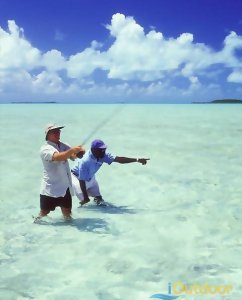
The fish responsible for making the Florida Keys and Key West backcountry and flat fishing famous is none other than the bonefish. Bonefishing is a catch and releases sport that is quite popular in Florida. Catching bonefish is quite a challenge even to the most hardened anglers. This is because the bonefish is built for speed. It requires lightning-quick runs with the drag system of the greatest tackle to be able to catch this fish.
The Gray Ghost
The bonefish is known by the name “The Gray Ghost” for its silver color with a blue or greenish color in the back. It has a slender and round body with a long drawn snout and an overhanging and downward pointing mouth. The bonefish can be found in the inshore water of the Atlantic Ocean, Gulf of Mexico, and the Pacific Ocean. This type of fish likes to dwell in shallow waters but go back to deeper waters with the tide. Other areas where this fish can be located are in grass flats or white sand flat, usually in waters that are less than three feet deep. Bonefish is often seen in multiple numbers especially in shallow flats while scavenging for food.
Successful Bone Fishing
There are different ways to fish for bonefish in the flats of Florida. One type is to use light tackle with live bait. Bonefish feed on shrimp and crabs. Baiting them with live shrimp can prove to be successful. Light tackling bonefish can also be done with artificial bait.
Fly fishing can also be used to catch bonefish and is a big technique when boning in the Keys. When fly fishing, it is best to use a number 7 to 9 weight fly rod that comes with a complimentary weight reel. It should also have lots of backing and have a fluorocarbon leader system. Fly patterns that can reel in bonefish include Crazy Charlie, Borski shrimp, and Merchant Crab.
Hooking a bonefish may be easy enough; the real challenge, however, is in reeling them in. So once a bonefish is hooked, anglers should hold on tight and let the drag burn as they are positioned for a fight. Being able to catch a bonefish is one victory that can repeat itself over and over again with still that same glorious feeling of achievement.
iOutdoors Blog, Key West Fishing, Sail Fishing
Florida Deep Sea Fishing Trip
Florida Deep Sea fishing can be extremely lucrative to the customer if done right. Many people plan out a Florida deep sea fishing trip with family and friends. If you take the time to carefully plan out these trips you will have a successful trip.
All fishermen know that the best fishing trips are the ones that are carefully planned out in advance. There are several things you need to consider when planning a Florida deep sea fishing trip. These include things such as the weather and the type of fish you are going to look for.
First, you will need to decide whether or not you are going to charter a boat. Many people like to take their own boats out, but sometimes it is nice to head out on a charter boat. If you want a more private setting then you will definitely want to take your own boat out on the water for the day. If you do not own your own boat there is no need to worry. The reason for this is that you can easily rent a boat for a day. It is not too expensive to rent a boat for a day and it is well worth the investment!
Many people don’t take the proper time to plan out fishing trips. You will want to plan out your fishing trip at least one or two weeks in advance. The reason for this is that it will allow you to invite friends and make sure you have all of your necessary supplies. Sometimes people are busy, so you will want to invite your friends weeks in advance. This will ensure that all of your best buddies are with you on your fishing trip.
Fishing trips are great, but a successful Florida Deep Sea Fishing trip is never complete without the proper food. Many people like to cook their own food the night before a fishing trip. The problem with this is that cooking your own food can take a lot of time.
Another problem with this is that not everyone is a world-class chef! If you are not good at cooking there is no need to worry. The reason for this is that you can easily order some sandwiches from a local deli. Normally, there is a deli located next to most docks.
Another thing you should consider is the safety of all the people on board. Many times young children are brought on fishing trips with their parents. The problem with this is that they may not be able to swim. This is why it is extremely important to bring a life jacket on board for young children. It is also important for the adults on the boat to wear a life jacket. The reason for this is that you never know what is going to happen when you are on a fishing boat. Sometimes, the seas can get choppy unexpectedly.
Safety should always come first when planning a Successful Florida fishing trip. Therefore, a first aid kit is a must-have when it comes to gathering supplies for a possible trip. Sometimes, a person may fall unexpectedly or accidentally scrape themselves on the side of the boat.
Florida is the Ultimate Deep Sea Fishing Destination. You truly can’t beat the variety of species along with locations you can fish. When it comes to Deep Sea, the Florida Keys especially Marathon have Offshore Fishing to die for. Miami, Naples, Daytona and Cape Canaveral are also very popular destinations for excellent fishing. Whether you are looking for a nice ocean ride in an open fisherman or a cool air-conditioned environment for the kids, we have you covered here at iOutdoors.
~~~Your Adventure Starts Today~~~
If you enjoyed this post about Saltwater Fishing, you might also enjoy our Fishing Blogs.
Don’t forget to follow us on Facebook, YouTube, Twitter and Instagram.
Charter Head Boat, Drift Fishing, iOutdoors Blog, Islamorada Fishing, Key West Fishing, Shark Fishing
I’m sure that our recent run of frigid weather has had more than just a few folks seriously contemplating a trip south for a chance to thaw out under a palm tree, where the water isn’t solid and dressing for cold weather means putting on a T-shirt. Florida has always been a popular winter getaway for a lot of anglers.
But if you think you know Florida but have never been to the Keys then you don’t know the half of it. Miami, Palm Beach, Fort Lauderdale, Daytona and so many of the other big coastal cities of the state have their share of fishing and a whole lot more to keep folks busy. But for some of us, it’s the “whole lot more” part of the big cities that has us bypassing them altogether as we beeline our way straight for the Keys.
You know you’re in a place that caters to fishermen when you can buy ballyhoo and chum in grocery stores or get a mixed drink in bait and tackle shop! Yea, leave the glamour and the glitz up in Miami, the Keys is all about fishing. And when it comes to fishing, the opportunities are about endless.
The Keys are a chain of Islands that stretch about 120 miles from Florida’s mainland to Key West with the Overseas Highway linking island to island and allowing travelers to drive across some of the most beautiful waters in the world. Headed south the ocean is on the left side of the highway and the Gulf of Mexico on the right.
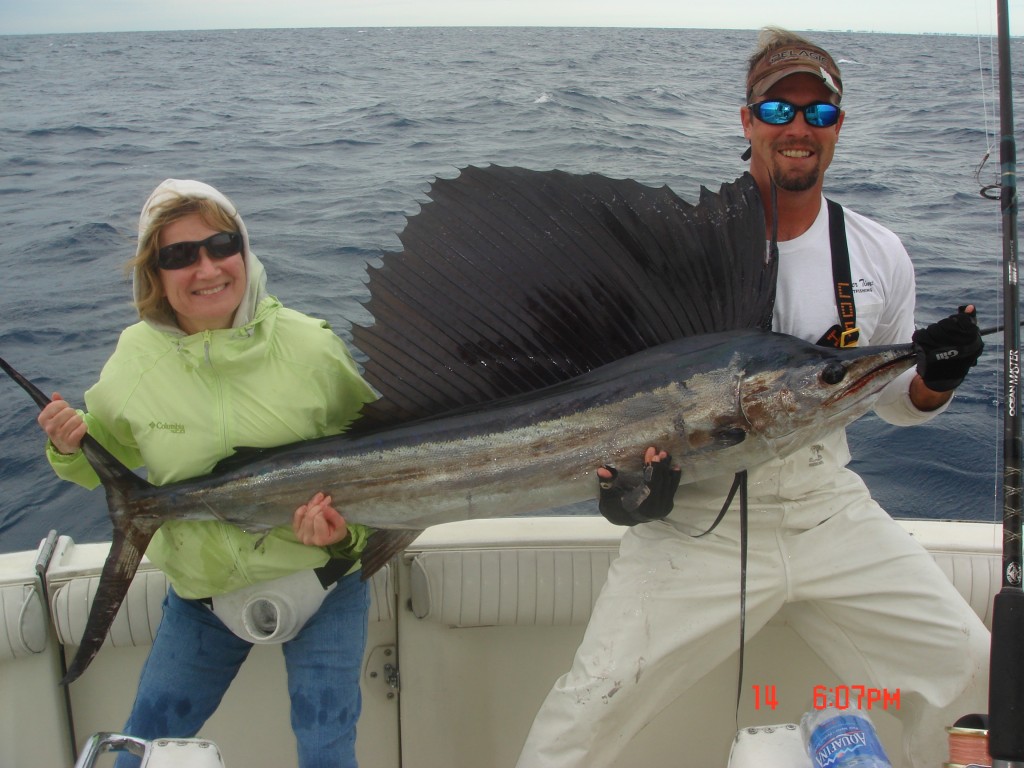
On the ocean side, it’s about a 5-6 mile run to the main reef which is a great place to fish the bottom for snapper, grouper, yellowtail and countless other structure oriented species. Just beyond the reef, the water drops down to a few hundred feet and has anglers in the zone for catching sailfish, marlin, dolphin, tuna, wahoo, king mackerel and even Swordfish.
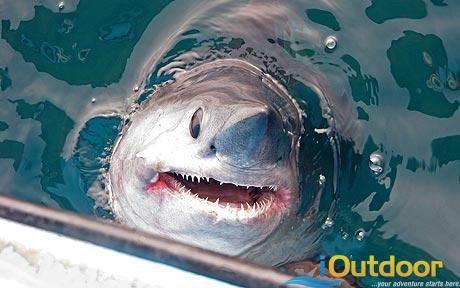
On the Gulf side of the highway, the water stays relatively shallow, like 1-12 feet, until you get 6-12 miles out and then it starts to slope down to 30 or more feet. The shallow water zone is where anglers do the “flats fishing” and target bonefish, tarpon, redfish, permit, sharks, barracuda, jacks and other fish that frequent the shallow water.
Much of this is “sight fishing” whereby the angler stands on the bow of the boat as someone else stands on a platform at the stern and quietly pushes the boat ahead with a long pole. Lines don’t go into the water until a fish is spotted and the boat is moved to within casting range.
Anglers also find that the channels between the Gulf-side flats hold a variety of fish including snapper, grouper, yellowtail, tarpon, cobia, sharks, speckled trout, jacks and mackerel. Since many of these channels are somewhat sheltered from the wind by surrounding mangrove Islands, they are particularly attractive to anglers on windy days when the oceanside reefs are too rough to fish.
While the waters of the Keys offer fly fishing opportunities that attract and challenge some of the best fishermen in the world, they also provide simplistic fishing where even the most novice angler can sit on a dock with nothing but a hand-line, a hook, and a little bait and catch fish after fish, and perhaps even bring home dinner.
In fact, there are so many bridges, piers and shorelines to fish in the Keys that some folks successfully fish for years down there without ever stepping into a boat.
So if you’re looking for a place to thaw out for a while — head to south Florida. But if you also want to enjoy some exceptional fishing in a naturally beautiful environment rather than being surrounded by tall buildings and neon lights — be sure to make it all way down to the Florida Keys. By the way, I’ll be guiding down there in March and April and I’m always happy to answer calls or emails from folks who are new to the Keys and looking for local fishing information.
Contact me through my BigSharks.com website.
Written by Mark Sampson

Water Sports, Charter Head Boat, Inshore Fishing, iOutdoors Blog, Key West Fishing, Miami Beach Fishing, Offshore Fishing, Party Boat Fishing, Sport Fishing, Wreck Fishing
SAFETY AT SEA AND YOUR CHARTER.
Charter Boat laws:
Operating a Charter Fishing operation requires more than just a captain and a boat. The Captain must hold a current USCG license with homeland security TWIC card. To be a saltwater Fishing Guide in Florida, you must also comply with U.S. Coast Guard (USCG) requirements. The U.S. Coast Guard (USGC) requires all operators of for-hire vessels to have a Captain license. Charter vessels must also be commercially registered. Charter, headboat and saltwater fishing guide operations must have an FWC charter captain or boat license to cover their passengers, who are not required to hold a recreational saltwater fishing license.
This license allows the captain and vessel to engage in charter fishing, whale watching, SCUBA diving, and tour cruises. This license is limited to near coastal waters only not more than 100 miles offshore and is not valid for international voyages. He must be enrolled in a random drug testing program, and carry a current first aid card. The boat must meet USCG – UPV standards (for 6 or less guest). There are many additional safety items required on a charter boat than a recreational boat. Trash and pollution place-cards are required onboard, as well as an emergency plan. Coast Pilot, Tide Charts and Light List for the waters operated are required onboard. Type 1 PFD’s with a whistle, lightened reflective tape are required for everyone on board. A life-ring is also required. This and the PFD’s are required to include either the boats name or registration numbers. Though inspections are not required, it is best if it is done to ensure compliance.
A state fishing license must be provided for all guest fishing on the boat. Federal (NOAA) Fishing Permits are required if the boat will engage in any fishing activity past state lines (3 miles Atlantic – 9 miles Gulf). Although VHF’s nor GPS locators are not required, they should be considered as a very important safety equipment that should be on every boat. Properly licensed Captains and charter operations spend a good deal of money to be so, and will not mind showing these required licenses and permits. If a charter operator will not show you these, then it may be best to look elsewhere.
Always make sure your boat and captain has these safety items on board:
-
- Working radio.
- A correctly fitting life preserver for each passenger.
- Signaling devices both visual and audible such as flairs, whistle and/or hand held air horn.
- Anchor.
- Some type of shade.
- Plenty of fresh water.
- Fire extinguisher.
- A throw-able flotation device.
- First aid kit.
You can do your part by:
-
- Wearing proper clothing for a day out in the elements.
- Using alcoholic beverages moderately.
- Following the instructions of the captain, guide or mate.
- Getting plenty of sleep the night before and staying hydrated.
- Wear sunscreen and a hat. The Florida sun can be brutal.
- Proper shoes that protect your feet and boat deck.
- A life jacket is no substitute for adult supervision of children in and around the water. Children float differently than adults. Because their body weight is distributed differently, children are more likely to float face down in the water.
If you are not sure the boat you are chartering has the necessary equipment ask your captain or guide to show you. If he does not or cannot comply think twice about continuing your charter. Your safety is your ultimately your responsibility, don’t leave it up to the other guy, insist on good boating safety practices!


Offshore Fishing, Destin Fishing, iOutdoors Blog, Islamorada Fishing, Key West Fishing, Miami Beach Fishing
Burial At Sea
Scattering of Ashes.
 The desire to spread or scatter the ashes of a loved one in a special place is an ever increasingly popular choice. It is a dignified and simple alternative to the conventional funeral and iOutdoor can help you make arrangements with a captain and vessel to provide this service. A funeral at sea is a time-honored tradition. It is less costly than a conventional funeral and in many ways is much more refined. We provide for a private charter to take up to 6 attendees out for the scattering in most major ports in Florida. If you are unable to go out to sea, one of our captains will take the cremated remains offshore and scatter the ashes for you. Unattended we provide a respectful, dignified sea scattering service locally in most major ports in Florida. Call iOutdoor and for availability and costs.
Burial at Sea–Rules and Regulations.
Ocean Scattering… As no special permitting is required for this in Florida, you may also do the scattering yourself. There are certain requirements as set forth below for all ocean remains scattering. This is the actual Environmental Protection Agency rule on the burial of human remains at sea.
Sec. 229.1 Burial at sea.
(a) All persons subject to title I of the Act are hereby granted a general permit to transport human remains from the United States and all persons owning or operating a vessel or aircraft registered in the United States or flying the United States flag and all departments, agencies, or instrumentalities of the United States are hereby granted a general permit to transport human remains from any location for the purpose of burial at sea and to bury such remains at sea subject to the following conditions:
(1) Except as herein otherwise provided, human remains shall be prepared for burial at sea and shall be buried in accordance with accepted practices and requirements as may be deemed appropriate and desirable by the United States Navy, United States Coast Guard, or civil authority charged with the responsibility for making such arrangements;
(2) Burial at sea of human remains which are not cremated shall take place no closer than 3 nautical miles from land and in water no less than one hundred fathoms (six hundred feet) deep and in no less than three hundred fathoms (eighteen hundred feet) from (i) 27 deg.30’00” to 31 deg.00’00” North Latitude off St. Augustine and Cape Canaveral, Florida; (ii) 82 deg.20’00” to 84 deg.00’00” West Longitude off Dry Tortugas, Florida; and (iii) 87 deg.15’00” to 89 deg.50’00” West Longitude off the Mississippi River Delta, Louisiana, to Pensacola, Florida. All necessary measures shall be taken to ensure that the remains sink to the bottom rapidly and permanently; and
(3) Cremated remains shall be buried in or on ocean waters without regard to the depth limitations specified in paragraph (a)(2) of this section provided that such burial shall take place no closer than 3 nautical miles from land.
(b) For purposes of this section and Secs. 229.2 and 229.3, land means that portion of the baseline from which the territorial sea is measured, as provided for in the Convention on the Territorial Sea and the Contiguous Zone, which is in closest proximity to the proposed disposal site.
(c) Flowers and wreaths consisting of materials that are readily decomposable in the marine environment may be disposed of under the general permit set forth in this section at the site at which disposal of human remains is authorized.
(d) All burials conducted under this general permit shall be reported within 30 days to the Regional Administrator of the Region from which the vessel carrying the remains departed.
The following Notice to EPA is required to be filed within 30 days.
All burials conducted shall be reported within 30 days to the EPA Region in writing. The following information should be included and mailed or faxed to the appropriate Region. You can copy the information below or complete and print the Region 4 burial at sea form (PDF)
| NAME OF DECEASED: |
| DATE OF BURIAL/SCATTER: |
| TYPES OF REMAINS: |
Cremated ( ) |
Non-Cremated ( ) |
| LOCATION OF BURIAL/SCATTER |
|
Latitude: |
|
|
|
Longitude: |
|
|
|
Distance from shore:
(minimum of 3 nautical miles) |
|
Depth of water: |
|
|
| VESSEL NAME: |
| VESSEL POINT OF CONTACT |
|
Name: |
|
Phone: |
| PORT OF DEPARTURE: |
| FOR NON-CREMATED REMAINS |
|
Did the remains appear to rapidly sink to the ocean floor?
Yes ( ) No ( ) |
| DIRECTOR OR PERSON(S) RESPONSIBLE FOR BURIAL ARRANGEMENTS |
|
Name: |
|
Phone: |
Islamorada Fishing, Key West Fishing
Get Married on a boat!
Getting married in the Florida Keys can be a spectacular and romantic event and iOutdoor can help arrange a memorable experience for you and your wedding party aboard one of our safe and comfortable boats. The Keys are filled with fabulous locations to tie the knot and what better way than to say “I Do” than on the sparkling waters of the Keys. If you’re considering a tropical wedding then look no further than the beautiful beaches and pristine aqua blue waters of the Florida Keys! iOutdoor can help you select just the right captain, vessel size and location for your wedding or party.
Whether intimate, simple or grand, we will assist you in finding the right captain and boat in the best location. Add a touch of excitement and an exotic location to your wedding by taking your vows on the water in the beautiful Florida Keys! Why have a traditional wedding when you can have an adventure to be remembered for a lifetime!
A Keys Wedding On the Water.
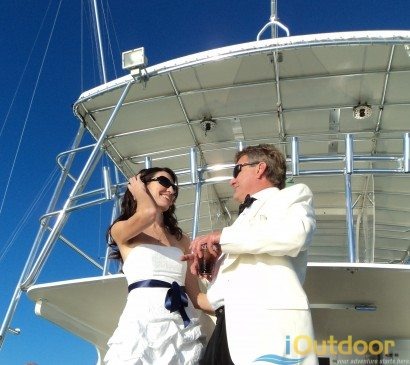
On December 28, John and Elena Elsea got married on board the That’s Right in Islamorada, Florida with Captain John Oughton. How do you picture your wedding in the Keys? Take a look below! This was a beautiful ceremony, a fabulous setting for a very classy couple!


