![Tuna – About the Species and Characteristics]()
Destin Fishing, iOutdoors Blog, Islamorada Fishing, Key West Fishing, Miami Beach Fishing, Tuna Fishing
 Tuna – About the Species and Characteristics
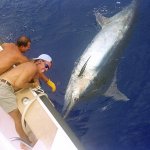
Tuna are sea water fish belonging to the family Scombridae, mostly belonging to the genus Thunnus. Tuna are known to be fast swimmers and are capable of swimming up to speeds of 70 kilometers per hour. Tuna is unlike other fish because its muscle tissue ranges from pink to dark red which is owed to their myoglobin levels, which is found to be higher in tuna than in other fish.
Physical Characteristics
The tuna is a streamlined fish, stout in the middle and then tapering to points at both ends. Two closely spaced dorsal fins can be found rising from its back. There are also seven to ten yellow finlets that fun between these fins and the tail. The tuna has a very slender caudal peduncle which has three stabilizing keels on each side. This species’ dorsal side is generally metallic dark blue in color while the underside is silvery or white.
Distribution
Tuna are considered epipelagic-to-midwater fish, which means they inhabit the upper and middle layers of ocean water. They can be found in oceans all over the world except in polar seas. They roam long distances in an extensive north-south pattern and even the transoceanic migration patters. These fish migrate on a yearly cycle.
Behavior
Tuna normally travel in small schools which range from six to 40 fish. Their prey depends on what is locally available but their common food is herring, menhaden, hake, cod, bluefish, whiting, mackerel, squid and crustaceans. Their large size owes their lack of or few predators like the billfish, sharks, and toothed whales.
![Tuna – About the Species and Characteristics]()
Destin Fishing, iOutdoors Blog, Islamorada Fishing, Key West Fishing, Marlin Fishing, Miami Beach Fishing, Offshore Fishing
When trying to land that trophy marlin or, if you are ambitious enough, a thousand-pounder, you need all the information and help that you could find. When trying to catch the marlin of your dreams, try using these lures.
 1. Mold Craft Wide Range
What is so great about the Mold Craft Wide Range is that it can be used in a wide range (thus its name) of conditions and speed. Thus, it is a favorite among anglers who want to land the big fish because it can be used in rough waters. This feature is accomplished by the center hole and squared-off nose.
2. Pakula Lumo Sprocket
The Pakula Lumo Sprocket was designed mostly as a straight runner and has a very tight swimming action. Lures by Pakula were first marketed in Hawaii for many years before these were sold in Australia, then, and the rest of the world.
3. Mold Craft Super Chugger
One of the lures you really must have, the Mold Craft Super Chugger has a concave face that enables it to grab a gulp of air which it then lets out in a thick bubble stream. This lure also moves in a side-to-side wiggle so that it resembles the swimming movement of fish.
4. Joe Yee Super Plunger
The Joe Yee Super Plunger is among the most popular and most widely used plungers, worldwide. A favorite by many anglers, these lures have caught their fair share of thousand-pound marlins.
5. Marlin Magic Ruckus
Another favorite among anglers, the Marlin Magic Ruckus is among the most productive lures used for catching marlin.
![Tuna – About the Species and Characteristics]()
Destin Fishing, iOutdoors Blog, Islamorada Fishing, Key West Fishing, Marlin Fishing, Miami Beach Fishing, Offshore Fishing
Top 5 largest marlin caught in the Atlantic
Marlin is a prized game fish, mostly because it offers a big challenge to the angler as it fights long and hard.
1. By Peter Ganz
The Atlantic Blue Marlin caught by JPeter Ganz was estimated to be 1,400 lb. It was caught off the waters of the islands of Azores, a Portuguese archipelago – near the Faial Island. This fish was not hauled in but was tagged, revived, and released back to the waters. For sure, this fish is among the largest caught.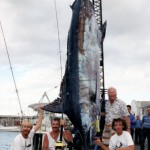
2. By Jacky Delbrel
Jacky Delbrel caught a 1,189 lb Atlantic blue marlin, again in the part of the Atlantic Ocean in the Azores, near the island of Faial. This catch holds the IGFA 80-pound world record for Atlantic Blue Marlin.
3. By Jean-Paul Richard
A 1,157-lb Atlantic marlin was caught by Jean-Paul Richard in Madeira. Caught along with this thousand-pounder was slightly smaller thousand-pounder weighing 1,028 lbs.
4. By Jack Harrington
It was on June 26, 1974, that the first thousand-pounder marlin was caught off the Oregon Inlet by Jack Harrington. Among the largest caught to date, this is worth mentioning especially since not too many thousand pounders have been caught. This marlin weighed 1,142 lb.
5. By Tracy Melton
Tracy Melton caught an Atlantic marlin weighing 1,083 lbs in Madeira. It was caught with an 80-pound tackle.
Of course, there are also plenty of marlins caught that are not listed here but could be heavier than these. There are also talks of the fish weighing as much as 2,000 lbs which were almost caught.
