![Joe as he caught his largest Tarpon ever….]()
Miami Beach Fishing, iOutdoors Blog, Offshore Fishing, Tarpon Fishing
Date: 09/26/2010: iOutdoor fishing trip,
Customer: Joe Del Giorno,
Miami Tarpon Fishing
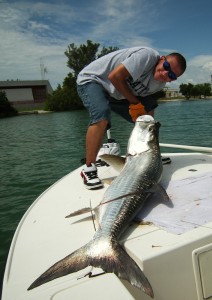
Joe as he caught his largest Tarpon ever….
Joe Del Giorno was able to break free on his last day in port after his 270 foot Coast Guard Cutter made a last minute decision to dock at Port of Miami. After removing the second largest amount of Heroin from the ocean on Coast Guard record, we knew the fish gods where going to bring a smile to Joe at some point in the day as a reward for his great service.
The day stated with a frown however, as a storm with no end in sight decided to great us at Homestead Bay Front Park where we thought we would be leaving in search of Lemon Sharks and Bonefish on the flats. Seeing the storm on radar made our decision to head back north and change gears for Tarpon that had been holding in a few areas.
With the mullet run in full effect north of Miami, I was happy to see the start of it here in Miami with finger mullet showering near the Tarpon areas. A few spot cast with the net and we were loaded with 4-7 inch finger mullet and decided to let them jitter nervously in between rolling Tarpon. These Tarpon are generally lock-jawed and some of the hardest to catch in Miami but they could not resist the jittering and soon there was the blast of a Tarpon and the scream of the rod. With several jumps, long screaming runs and hour of Joe’s great fighting technique; we landed the monster Tarpon estimated at 120lbs. It was Joe’s largest to date and something he will never forget.
Not long after, a rod slams down and a 80lb Tarpon sky-rockets towards the boat spitting a scale free mullet at Joe and me all the while landing head first 3 feet from the boat. It was incredible and you could actually see the Tarpon as he shot under the boat and out of site into the deeper water. Next up was a 30lber that Joe was able to land in about 10 minutes and take another photo. Shortly after we decided to try another spot that had been hot and we found it to be warm. Joe quickly jumped a 75lb Tarpon that may have provided the most spectacular jump of the trip. At this spot Joe was able to catch a monster Mangrove Snapper for day time fishing on a finger mullet which we released and fun with several 5-8lb Jacks that exploded on the finger mullet.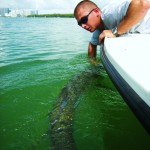
We had some great conversations and it was a great day for Joe as he caught his largest Tarpon ever. It certainly was a pleasure to fish with someone providing such a great service to our country. I look forward to Joe’s next stop in port.
Capt Tom
www.floridanativecharters.com
![Joe as he caught his largest Tarpon ever….]()
Bottom Fishing, Charter Head Boat, Fly Fishing, Grouper Fishing, iOutdoors Blog, Marlin Fishing, Offshore Fishing, Party Boat Fishing, Sail Fishing, Shark Fishing, Sword Fishing, Tarpon Fishing, Tuna Fishing
Offshore Fishing – What to Bring
 No matter how good your fishing skills are, sometimes, they are not simply enough to get that trophy catch. To assist you in this endeavor, fishing tackles can be used, which can highly improve your chances of snagging your dream blue marlin or bluefin tuna.
Fishing tackles, also known as “fishing gear”, are the physical equipment’s needed when fishing. Almost all gears and equipment’s used in fishing can be called fishing tackles from terminal tackles such as hooks to lines, sinkers, reels and rods to name a few. Because of their number, it is impossible for you to bring all of them in an offshore fishing trip. So that you will not over pack or leave anything essential, here are the top ten fishing tackles to use for offshore fishing, which can serve as your guide in packing.
- Fishing rod. The fishing rod is the most important fishing tackle you will ever need for offshore fishing. In choosing your fishing rod, make sure that its weight and length are perfect for you so that you will still remain comfortable using it despite hours of fishing.
- Fish Hook. Hooks are the devices that impale the fish in the mouth or body. During every fishing opportunity, make it sure to bring hooks in different sizes and styles so you’ll have plenty to choose from.
- Fishing line. A fishing line is a cord used in angling, its end being where the hook is attached. Important factors in choosing your fishing line are: length, weight and material. Remember that they must be tough enough to resist offshore fishes.
- Fishing sinker. A sinker is device which weight is used to improve casting distance and the speed of sink of the bait.
- Fishing reel. Reels are devices used together with a fishing rod to allow the deployment and recovery of a fishing line with the use of a spool supported by an axle.
- Fishing bait. Baits or lures, whether natural or artificial, can also make or break your fishing expedition. Choose your bait depending on the type of fish you would like to catch.
- Net. A net can be handy to secure a fish already caught because it would be agonizing to lose a prize catch at your feet.
- Tackle box. Of course, with the number of your fishing tackles, it would be easy to damage them, or worse, misplace or lose them. Thus, it is always wise to bring a tackle box where you can keep your fishing equipment’s, gears, accessories and baits.
- Fishing basket or cooler. Having caught a prize fish, of course, you’ll need a fishing basket or cooler where to store them.
- Right Fishing Outfit. Although most people who go fishing are keen on their fishing equipment’s and gears, they rarely think about their outfit. For practicability, make it sure that you wear comfortable clothes, fishing boots or waders if you intent to stand in the riverbank fishing, fishing vest with utility pockets, and a fishing hat to keep you protected from the rays of the sun.
You should Read this blog: Why Deep-Sea Fishing Should Be In Your 2021 Fishing Trip List

Tarpon Fishing, iOutdoors Blog, Offshore Fishing
TARPON!
One of the most memorable challenges anglers all over are bound to take is to tackle the Silver King or the tarpon in the waters of Florida. The Megalops atlanticus is commonly known by the name Tarpon. Anglers flock from different parts of the world to fish in Florida because it is here that many great numbers of Tarpon migrate to.
Tarpons up Close

There is little known about the Tarpon because it has no food value compared to other fish. What is known about the Tarpon, however, is that these are prehistoric animals dating back as far as 100 million years. Also, possess a unique organ called the swim bladder which enables them to breathe from the atmosphere. Tarpons, in their early stages of life, typically stay in shallower waters. However, once they grow to about two feet, they move to larger bodies of water. Tarpons are usually found in deep, man-made canals and holes far up the coastal rivers of Florida and in the upper reaches of large bays.
Tips in Tarpon Fishing
Never go out tarpon fishing unprepared and without any foreknowledge whatsoever. What is being caught are not little fishes but giant ones that can actually exhaust any novice fisherman. The key to successful tarpon fishing is to find northbound schools on the beach. This situation usually presents itself after the first full moon in June. Compared to southbound tarpons, northbound tarpons are hungry and are more likely to stop for bait.
After the right type of tarpon is found, proper presentation and good bait are all that is needed to make the catch. Anglers should distance themselves from their targeted tarpon from a 50-foot gap. With tarpon fishing, overcasting is always a good idea. Next is to land the bait in just the right depth. The bait should be thrown so that it would sink around 8-10 feet just barely above the tarpon’s head and line of sight. Remember, they are easy to spook fish. Once a tarpon is spooked, anglers risk losing not just one tarpon but the whole school of them. Lastly, when a tarpon hooks on to the bait, anglers should most definitely hold on.
Tarpon Charters
For novice fishermen or anglers new to tarpon fishing, Florida offers many tarpon fishing charters. With their help, visitors will be guided on the right equipment, the right fishing technique, and as well as the right bait to use for successful tarpon fishing in Florida.
Marathon Tarpon Fishing Charters
![Joe as he caught his largest Tarpon ever….]()
Fly Fishing, iOutdoors Blog, Tarpon Fishing
Fly Fishing for Tarpon
Tarpons pose as a great challenger for fly fishers for many reasons. They are huge, no wonder they are called Silver Kings. Tarpon are also capable of jumping up to 6 feet in the air and their mouths are solid bone. Fly fishers often find it hard to land one over 100 pounds.

Fly Fishing Tips
The best time to fish for Tarpon in Florida is sometime around January, February and March. The next best thing to do to increase the likelihood of catching a Tarpon is to hire the right guide. There are many factors that work against fishermen when it comes to fishing for this fish. Hiring a guide will beat these factors. Another great tip when it comes to fly fishing for Tarpon is in using the right fly. Aside from using the right fly, it is also important to note other factors such as the tide, the current, the time of day, fly pattern, temperament of the fish, the Line Leader combination used, and the presentation of the fly.
Recommended Tarpon Flies and Gears
Fishermen usually have their own preferences when it comes to choosing the right fly. The most commonly used flies for tarpon fishing include the cockroach, the baby bunker and the whistler. Presentation of these flies is absolutely important. Tarpon can be easily spooked and can even flee even with a well-presented fly.
As for fishing gear, different gears should be used depending on the size of the Tarpon anglers want to catch. For normal-sized Tarpon, a 10 weight with floating, clear floating, and additional “clear sink tip” line is necessary. For catching big Tarpon, 11 weight with floating, clear floating and additional clear sink tip is best. A 12 weight can also be an option especially on windy days together with an intermediate line to cut through the wind.
The type of leaders and leader materials used should also be considered as it can have great bearing to the success of fly fishing a Tarpon. So, with the right gear and the right guide, fly fishing can prove to be a successful event for Tarpon enthusiasts, for both novice and angling experts.

 No matter how good your