Bottom Fishing, Drift Fishing, iOutdoors Blog, Offshore Fishing, Party Boat Fishing, Snapper Fishing
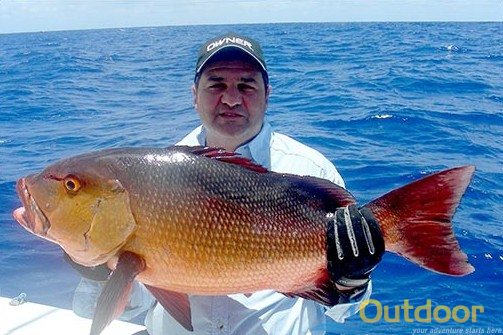
 How many different types of SNAPPER are there in Florida waters?
Snappers, particularly the red snapper, are quite common game fishes in Florida waters. Known to thrive in estuaries up to depths of 450 meters, they feed in freshwater in search of smaller fishes and crustaceans though a few species’ main diet consists of planktons. Florida is the perfect place for snappers to thrive since they prefer warmer climates. In perfect conditions, they can grow up to one meter in length.
All over the world, there are more than 100 species of snappers discovered. Some of them can be found in the waters of snapper in Florida. Here are the top five most popular snapper species in Florida:
- 1. Red Snapper
The Red Snapper is the most popular snapper in Florida because of its amazing size which could grow from 3 pounds to 50 pounds. Areas to find it in the state during open season include bridges and piers, and also offshore on the continental shelf particularly off the Panhandle and Northern coasts.
- 2. Mangrove Snapper
Also known as the Gray Snapper, the Mangrove Snapper is also widespread in Florida’s saltwater. It is called as such because they congregate in small mangrove areas all around the state. Other than mangroves, juveniles can also be found inshore in inland waterways, tidal creeks, and grass beds while adults typically thrive nearshore and offshore in wrecks, rock, and coral reefs. Popular areas to catch it include the areas of Clearwater, St. Petersburg, Sebastian, and Daytona.
- 3. Yellowtail Snapper
Most distinguishable due to its yellow tail, the Yellowtail Snapper is smaller but just as tasty compared to its cousin, the Red Snapper. Feeding mostly on shrimps, it can be caught offshore in Florida up to depths of 300 feet. During the summer months, it is most abundant in the Florida Keys.
- 4. Mutton Snapper
One of the largest snappers, the Mutton Snapper can be found in South Florida especially during the months from spring to fall when they spawn. It can be found in inland areas along mangroves and canals where it feeds on preys like smaller fishes and snails. It can also be sporadically caught in the Gulf Coast such as the Middle Ground.
- 5. Cubera Snapper
This fish is the largest of the snapper family, growing up to more than 110 pounds in size. Juveniles can be found conglomerating inshore in grass beds while adults thrive nearshore and offshore in rocky reefs, ledges, and wrecks where they feed on fishes and crustaceans. The Cubera Snapper is mostly predominant in the Florida Keys especially during late summer when they spawn.
Other species of the Snapper family that can be found in Florida include the following: the Lane Snapper, Mahogany Snapper, Blackfin Snapper, Dog Snapper, Queen Snapper, Schoolmaster, Silk Snapper and Vermilion Snapper.
![What is a depth finder used for?]()
Bass Fishing, Bottom Fishing, Drift Fishing, Grouper Fishing, iOutdoors Blog, Offshore Fishing, Party Boat Fishing
What is a depth finder used for?
The technology used in depth finder originated during the World War II when solar technology was invented to give the Allied powers advantage over the Axis’ elusive submarines. This same technology is being used today to aid anglers catch fish lurking under the water.
A depth finder, also called a fish finder, is a hi-tech fishing tool that uses sonar (Sound Navigation & Range) to detect the bottom of the water and fish, displaying them on a remote display screen for the angler to see. 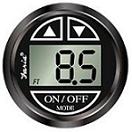
A device attached to the bottom of the watercraft transmits sonar waves through the water below, and when they hit an object, whether a fish or waterbed, they bounce back. The transmitter receives the signals back and analyzes them, displaying its findings on a small display screen. The screen then provides a visual representation of the underwater including the objects and waterbed underneath the watercraft. Depth finder technology is so advanced these days that they could distinguish between objects like seaweeds, waterbed, trash, and of course, fish; and represent them with instantly-recognizable symbols on the screen.
For anglers, they hope that their depth finder will bounce back signals of an elusive fish. Because anglers are given an approximate picture of the underwater, it could allow them to know the location of the fish. Most depth finders today could also provide an estimated depth of the fish, thus, also allowing anglers to know how deep their lures should be. The ability of the depth finder to determine the depth of the bottom of the sea or lake, also allows anglers to refrain from wandering off into shallow waters that could damage their boats.
There are several manufacturers of depth finders today including Eagle, Furuno, Garmin, Humminbird, Lowrance, Magellan and Raymarine. Some of the models sport the latest in scientific advancement such as GPS technology and electronic compass displays among others.
![What is a depth finder used for?]()
Bottom Fishing, Charter Head Boat, Drift Fishing, Grouper Fishing, iOutdoors Blog, Party Boat Fishing
Five Great Depth Finders
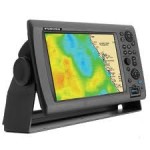 Depth finders are among the best equipment to bring on your fishing trip. You’ll surely be able to land that big fish of your dreams, if you know how to use these gadgets. Let’s list 5 of the best depth finders available in the market.
1. Lowrance
A lot of anglers would swear by Lowrance depth and fish finders. This brand has a wide range of gadgets that offer advanced GPS systems that let you calculate your position within 10 ft; thus, it is often favored not only by serious anglers but hunters, professional pilots, and backpackers as well. What’s so great about Lowrance products is that most have a built-in feature that offer full color display screens and displays various underwater conditions like temperature. Also, some models can even store coordinates of up to 1000 different locations.
2. Humminbird
Products by Humminbird are relatively cheap yet are able to provide readings of up to 600 ft and can be used even at speeds on 70 mph. These products are easy to install, easy to figure out, easy to use, and dependable. Just remember to keep it dry and away from saltwater.
3. Garmin
Garmin depth finders are in full color with a dual beam transducer which makes it quite accurate not only for finding fish under the boat but also along the sides. It can even be easily mounted on the trolling motors – you won’t need an adaptor.
4. Norcross
Norcross offers no-frills products that will show you the depth, precisely for up to 200 ft even at 63 mph. It has shallow and deep water alarms. It is also waterproof.
5. Uniden
Uniden provides products that have a large, backlit LCD screen precisely showing depths from 2.5 ft to 199 ft. It features shallow water alarms.
![What is a depth finder used for?]()
Backcountry Fishing, Bottom Fishing, Drift Fishing, Flats Fishing, Fly Fishing, iOutdoors Blog, Permit Fishing, Redfish Fishing, Sail Fishing, Snook Fishing
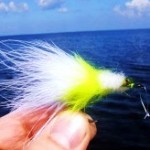 Should you sharpen a new hook?
Compared to a greenhorn fisherman, a seasoned fisherman will spend some time sharpening fishing hooks. If a recent fisherman would ask a veteran in fishing whether or not a new hook should be sharpened, his answer would surely be yes.
Whether you are a simple beginner fisherman or an experienced angler offshore angler, your point of contact with a fish is by the hook. It is the hook that lures a fish towards you, thus, making it a critical tool in fishing. The importance of the hook, especially a sharp hook, cannot be gainsaid especially when using crankbaits and similar baits where the grip of the hook to the mouth of the fish is extremely low.
Check your Hooks
To check your new hook’s sharpness, don’t just rely on the package when it says the contents are sharp. It is worth to check its sharpness by drawing its point across your fingernail. If it doesn’t leave a mark at the gentlest draw, then it is not sharp enough and needs some sharpening.
Although new hooks are sharp, sometimes, they are not sharp enough, thus, the need to sharpen them. Sharper hooks could land more fish especially when flats fishing, fly fishing, and sailfishing. A hook, although new, when not sharp enough could lose that high-priced fish you could have caught! Thus, the need to sharpen even a new hook in preparation for a fishing expedition.
Even while fishing, you should also be conscious of the sharpness of your hook especially when you have used them after a few casts or when you’re fishing in rocky areas. Once in awhile, touch the point and hone it if it is dull, otherwise, it won’t stick into a fish’s mouth.
Learn more about how to get your hooks as sharp as possible!
![What is a depth finder used for?]()
iOutdoors Blog, Bottom Fishing, Marlin Fishing, Offshore Fishing, Sail Fishing, Shark Fishing
Sailfish, Marlin and Shark all for Catch and Release!
There are some anglers who do not get the underlying philosophy behind catch and release. Although there are some communities that only allow catch and release for certain fish species, it is already a different story when catch and released is practiced voluntarily.
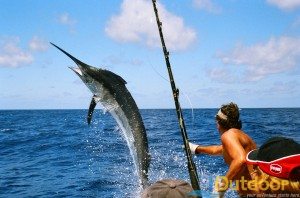
There is always the great debate between “catch and release” and “catch and kill”. For the proponents of catch and kill, they may ask: why release an injured fish back into the water when it will die anyway or why catch a fish at all if it you don’t get to keep it and serve it at the dinner table? Although the idea of a catch and release is not acceptable to many anglers, the practice could also be a good idea.
Catch and release is a recreational fishing practice of releasing a captured fish back into the water. The idea is to release the fish before its scale, skin and slime layers gets damaged, and before it suffers grave injury or exhaustion. Anglers would normally use bar-bless hooks to increase the fish’s survival, allowing it to be released without lifting it from the water.
Majority of the advocates of catch and release have ecological conservation in mind. For them, keeping a kill not for the need to survive but for sheer recreation is an abnormality in natural evolution. Releasing a prize catch back into the wild is the best thing any angler could do especially when it concerns fish species with dwindling population. Although there are many who doubt the survival of a captured-and-released fish, they have extremely high survival rates between 95% and 97%.
The conservation practice of catch and release will prevent the over-harvesting of fish that could gravely affect the marine food web chain. It will ensure a sustained population of fish species to safeguard the future of sports angling. Besides, most anglers would want to catch that large fish, but let’s face it, all of them are not that tasty. So, instead of enduring its taste on the table, why not throw it back into the water instead?
Bottom Fishing, Drift Fishing, Grouper Fishing, iOutdoors Blog
The Grouper –a bottom and drift fishing favorite!
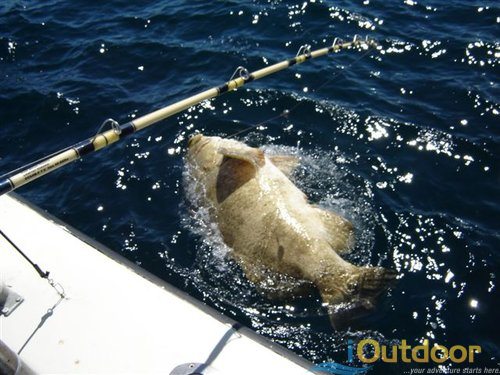
Groupers refer to any fish belonging to the subfamily Epinephelinae of the family Serranidae in the order Perciformes. There are different species of Groupers found all over the world.
Description
Groupers are classified as teleosts which mean that the fish has a characteristic stout body and large mouth. This type of fish is not meant for long-distance swimming. Groupers can be quite large and can grow to over a meter and weigh up to 100 kilograms. Rather than chewing or biting off bits, they swallow their prey whole. The grouper does not have many teeth on the edges of their jaws but they have extreme crushing tooth plates inside the pharynx.
They eat fish, octopus, crab and lobster. Rather than chasing prey in the open water, they lie in wait for their prey to near them. They have the ability to suck in their prey from a distance because of their mouth and gills that can perform a powerful sucking system. Groupers tend to hide under crevices when threatened. Their powerful gill muscles enable them to remain in their cave or hole if they feel attacked.
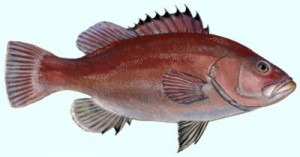
Habitat
Groupers are found in tropical and warm temperate waters worldwide. Different species can be found in different countries. The Nassau grouper can be found mostly in the Caribbean, while the Mycteroperca and Ephinephelus groupers are found throughout Florida. They usually prefer areas with caves and crevices that they can use as shelters.
Modern Use
Groupers are considered an important food fish and are eaten in many parts of the world. Because of this demand for groupers as food, the grouper and some of its species are now being farmed.
