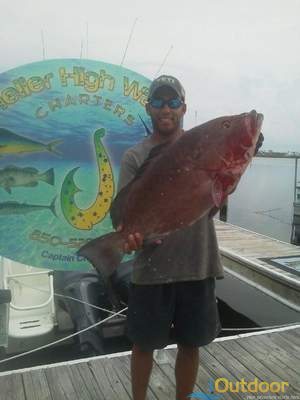
iOutdoors Blog, Grouper Fishing
In past years, Many different types of grouper, including black, red, yellowfin, scamp, yellowmouth, rock hind and red hind were off limits to anglers from Feb. 1 through March 31.
Now, the ruling has been removed for fishing in both state and federal Gulf waters shoreward of the 20-fathom line or about 120 feet of water. The closure of these species remains in place for anglers fishing seaward of the 20-fathom line in the Gulf of Mexico.
This closure was removed in state waters last September by the Florida Fish and Wildlife Conservation Commission (FWC) and for federal waters last summer by NOAA Fisheries.
The change does not apply to gag grouper in any Gulf waters. Gag grouper has its own season that opens July 1 and typically closes sometime before the end of the year when the quota is reached.
The original recreational shallow-water grouper closure was part of a suite of measures designed to achieve target harvest levels for red grouper and gag grouper.
Venting tool requirement
As of Jan. 24, Florida anglers no longer will be required to have and use a venting tool when fishing for reef fish such as snapper and grouper in Gulf of Mexico state waters. The rule requiring the use of a venting tool in federal waters was removed last fall.
Removal of this rule means anglers will have the freedom to determine how to best maximize survival of released reef fish using devices they feel are appropriate, depending on the circumstances.
Venting tools are hollow, sharpened instruments that provide one way to treat barotrauma, a condition that occurs when fish are brought quickly to the surface from deep water. The change in pressure from depth to surface can cause gases within the fish’s swim bladder to expand, which can damage internal organs and reduce the likelihood a fish will survive when returned to the water.
The use of non-stainless steel, non-offset circle hooks, and dehooking devices are still required in state and federal Gulf waters when fishing for reef fish. These tools minimize handling time for reef fish, which aids in the survival of the fish upon release.
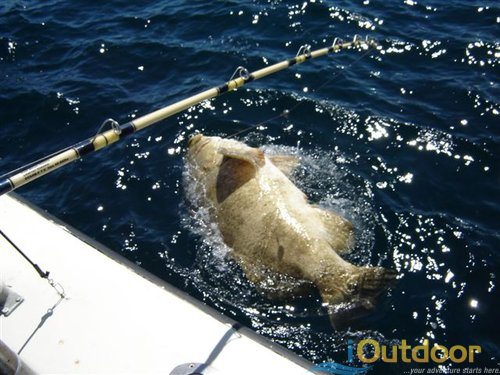
iOutdoors Blog, Grouper Fishing
The Feb. 1 through March 31 closure that would have affected several species of grouper in Gulf state waters has been removed and will not occur as it has in previous years.
This closure was removed at the September 2013 meeting of the Florida Fish and Wildlife Conservation Commission.
A similar closure was also removed in federal waters shoreward of the 20-fathom line, or about 120 feet (excluding waters off Monroe County). To learn more about the federal closure, visit the NOAA Fisheries Southeast Regional Office at Sero.NMFS.NOAA.gov and click on “Fisheries,” “Gulf Fisheries,” “Reef Fish” and “Gag and Shallow-water Grouper Framework – Recreational Season.”
The closure would have applied to the following species: black, red, yellowfin, scamp, yellowmouth, rock hind, and red hind.
The closure did not apply to gag grouper, which has its own season and opens April 1 through June 30 in state waters off Franklin, Wakulla, Taylor, and Jefferson counties; and from July 1 through Dec. 3 in all other state waters of the Gulf (excluding Monroe County, which is managed under the Atlantic season).
More information regarding Gulf grouper fishing regulations is available online at MyFWC.com/Fishing by clicking on “Saltwater Fishing,” “Recreational Regulations” and “Gulf Grouper.”
Fly Fishing, Backcountry Fishing, Bottom Fishing, Destin Fishing, Dolphin Fishing, Drift Fishing, Flats Fishing, Grouper Fishing, Inshore Fishing, iOutdoors Blog, Islamorada Fishing, Key West Fishing, Kite Fishing, Lobster Catching, Marlin Fishing, Miami Beach Fishing, Offshore Fishing, Permit Fishing, Redfish Fishing, Sail Fishing, Shark Fishing, Snapper Fishing, Snook Fishing, Sport Fishing, Sword Fishing, Tarpon Fishing, Trout Fishing, Tuna Fishing, Wahoo fishing, Wreck Fishing
What hook should you use for which fish?
Wow! Old as man itself but it can really be overwhelming when you start to choose a hook. Freshwater, saltwater, bait hooks,“J” hook, circle hook or live bait hooks. Hook choice is VERY important! As a general rule I judge the hook size I need to use as a function of the bait size I am using, not the size of the fish I am targeting. The fish I am targeting determines the bait size. I particularly prefer circle hooks- they virtually hook themselves and are very fish friendly in catch and release situations. Experience is the best teacher on hook selection- use the right hook for the right fish and type of fishing you are doing and be prepared have a selection of hooks at hand. One common mistake is using a hook that is to big. Imagine this – if I hook you in the arm with a small quarter size hook are you going to be able to get a way or are you going to follow me anywhere? A sharp point and a strong hook is much more important than the size. Except in the case of top water lures please consider twice before you use a treble hook- there is virtually no opportunity for catch and release using a treble hook and they are banned in many areas. Treble hooks are dangerous to fisherman as well- use them sparingly and only when you plan to kill and eat the fish. One very important rule: Even though a new hook seems sharp out of the package always, always sharpen your hooks before you use them and re-sharpen them often.
Fish hooks come in several types. Knowing a few of the more popular ones and their uses can help you be successful.
Which hook should you use for which fish?
 O’SHAUGHNESSY This hook is named for the specific design of the hook. It’s a standard hook, forged with a very strong bend. This hook is relatively thick, very strong, and not likely to bend out of shape. Generally designed for saltwater, it is good for general bottom fishing use. Sizes range from #3 to as large as 19/0.
 ABERDEEN These hooks, while primarily used in smaller sizes in freshwater, are also used by saltwater anglers. They are generally made from shaped wire. Unlike the O’Shaughnessy, it can and does bend. It can be bent back into shape several times before it becomes too weak. However, once a fish is hook and the barb has completely penetrated, this hook holds quite well. These hooks are modified with bends in their shanks for use in jig molds.
 CIRCLE Perhaps the best innovation in hooks to come along, circle hooks promote healthy catch and release. The design of the hook itself, when used properly, prevents fish from being hooked in the gut. Many anglers have a problem using these hooks because they require no hook set. If you do try to set the hook, it will generally come out of the mouth of the fish. These hooks are designed to move to the corner of the fish’s mouth and set themselves as the fish swims away from you. Anglers feel a bite and simply begin reeling, slowly at first, then faster as the hook gets set.
 LIVE BAIT These hooks generally have a shorter shank than other hooks. Whether that is to allow the live bait to swim more freely or to be less apparent to the fish is debatable. My vote is to allow the bait to swim more freely. These hooks come in regular and circle designs. Regular live bait hooks will be swallowed and result in gut hooks most of the time. Circle live bait hooks provide a greater chance for a good release.
 KAHLE The curve on these hooks makes them ideal for live bait. Made from the same wire as the Aberdeen hooks, they will bend if hung on the bottom of some structure. However, once a fish is hooked, the design of the hook prevents it from being straightened.
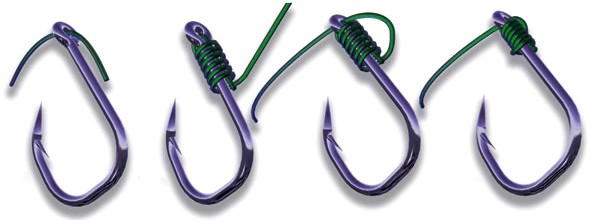
The Guide below provides an overview of the parts of a fishing hook. There are some common parts to all hooks. Those parts include the eye, shank, gap, point and barb. The variations on these characteristics result in dozens of hook styles.
Anatomy of a Hook
The Eye
The hook eye is the connection point to the fishing line or the body of lures. Ringed eyes are the most common. The metal is bent in a uniform loop and the end sits flush against the shank. Needle, looped and tapered are some other types of hook eyes, but they tend to be used for specific applications, like saltwater or dry flies.
The Shank
The shank is the length of the hook from the eye to where the bend starts. Shanks come in short, medium or long lengths. Short ones greatly reduce the size of the hook. Medium length shanks are the most common and used in an array of fishing situations. Long shanks can be used for live bait fishing where finesse isn’t critical, or to match a longer profile of an artificial bait.
The Gap
The gap is the size of the bend in a hook from the shank to its point. An average size gap will do in most situations, but sometimes a wide gap is needed. A wide gap is used for rigging thick-bodied baits to ensure that the hook point will be exposed on the hook set.
The Point
This is the tapered end of the hook. As its name suggests, it’s the sharp point that penetrates a fish’s mouth. The shape of the point will vary. Needle, knife edge, spear, or rolled ones are some examples. The most important thing, however, is that you keep your points sharp, so invest in a hook file and use it often. Quality hooks are packaged extremely sharp and will stay sharp longer than cheaper ones.
The Barb
The barb is designed to hold the hook in place once it penetrates the fish’s mouth. The larger the barb, the more difficult it is for the fish (and likely yourself) to get the hook free. Many catch and release anglers pinch barbs with pliers or file them down for easy hook removal.
Other Basic Hooks
 BAIT HOOKS come in a variety of styles. Most feature barbs on the shaft to hold bait in place. Longer shank hooks are good for teaching kids to fish, while shorter shank ones are often used in snells.
 TREBLE HOOKS feature three bends and points in one hook. Trebles provide more hooking potential to many artificial baits such as crankbaits, jerkbaits or topwaters. Bait anglers also use trebles. Cut bait for catfish or threading minnows for lake trout are two examples where trebles are regularly used.
 SIWASH HOOKS are quite strong and have a long shank and point. These hooks have a straight eye so they sit properly on lures. Siwash hooks are often used on single-hook baits, such as spinnerbaits. I also use them sometimes to replace factory-provided treble hooks on certain baits, especially spoons.

JIG HOOKS are designed to sit in specific jig molds. They feature a bend just below the hook eye, with a 90-degree bend being the most common. Pouring your own jigs can save you money and be a fun winter hobby to gear up for the next season

iOutdoors Blog, Grouper Fishing, Inshore Fishing, Trout Fishing
Location: Tampa Inshore
Captain: Chuck
Clients: Don Campbell and Greg Sweeney
Date: 01/20/2011
Today, I had the pleasure of taking clients Don Campbell and Greg Sweeney of Kansas City out for some fishing.
We started out trying to catch a few grouper in Tampa Bay, but only managed 1 small sea bass for our efforts.
I decided to take them to my secret grouper dock; where they landed a nice sheepshead and a couple of 20″ Grouper.
Seeing the tide was coming in, we decided to end the day fishing jigs on a little-known grass flat for SeaTrout.
These guys did not disappoint—together, they boated and released a dozen hefty winter Trout in the 15-24″ class.

Grouper Fishing, Inshore Fishing, iOutdoors Blog, Miami Beach Fishing, Offshore Fishing
What Kind of Bait Do You Use to Catch GROUPER in Miami?
 Groupers are among the most prized saltwater game fishes among sporting anglers. They are known for their strength and size including the Goliath Groper which can reach a weight of more than 650 pounds. They are also sought-after for their meat as they are considered of fine food quality. Known to thrive in warmer temperatures, they are abundant in Florida including the waters off the shores of Miami.
Artificial or Natural Bait?
There is no particular bait that can effectively and consistently catch a grouper since a bait that may have caught one may not again do so. That is why the technique to follow is to make available a variety of lures; the more the baits, the better.
You can choose between natural and artificial lures when preparing for a Grouper Fishing expedition in Miami. Although artificial lures are more convenient and have been scientifically designed, nothing beats the traditional way – using natural lures. Groupers’ main diet consists of crustaceans, octopuses, young sea turtles, and smaller fishes. You could purchase cut squid and baitfish in Miami tackle shops though some are only available during certain seasons in order to Catch Grouper in Miami.
Catching Your Own Live Bait in Miami
Although natural bait is more effective than artificial lure, there are some anglers who prefer live bait. Some of them even prefer to catch their own Grouper bait for several reasons especially when fishing offshore. First, fish baits may be hard to come by in tackle shops in Miami since some of them are seasonal. Second, they want to experience “old school” fishing where they create or supply their own materials including bait. Third, they want to use fresh baits since they are more lively, thus, are better lures as it allows more strikes. Freshly caught bait is always best to Catch Grouper in Miami.
Baitfish is abundant in Miami from Fall to Spring, especially in reefs, ledges, buoys, and markers. Because you are Sport Fishing for Grouper, you should choose baitfish that attracts Grouper the most like pinfish, pigfish, cigar minnows, giant pogey, mullet and squirrelfish. You can also use live crab or eel if available in Miami.
Bottom Fishing, Drift Fishing, Grouper Fishing, iOutdoors Blog, Party Boat Fishing
What is deep jigging?
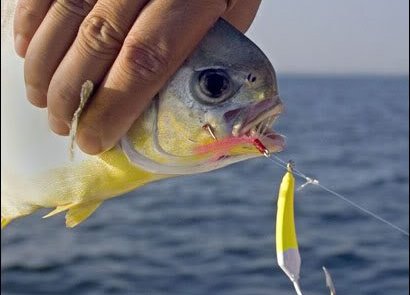
Deep jigging is the term used for fishing using jigs in a deepwater setting, usually more than 100 feet deep. This fishing technique is often employed to catch husky bottoms fish species such as mutton snapper, amberjack, and grouper. However, this can also be used of pelagic species such as cero mackerel, Spanish mackerel, and kingfish. Deep jigging is also great for catching wahoo and dolphin fish.
The Jigs
There are many different types of jigs you can use for deep jigging. These jigs were designed to imitate bait; thus, it comes in various shapes, sizes, and colors. You’ll find feathered jigs, bucktail jigs, feathered jigs, and many others. The rule of thumb is: the deeper you fish, the heavier the jig you should use.
Getting the Technique Right
As with any other fishing technique, you might not get it right the first time but you’ll soon master the technique with constant practice. Also, you’ll learn from trial and error – pretty soon, you’ll be catching that monstrous fish.
The best day to go deep jigging is when the winds and currents are not too strong but there has to be wind and current to make the jig move as it drifts over the bottom. The idea is to make the jig act like a real fish, make sure to limit the up and down movements in just one place – that is unnatural and easily spotted by the fish you are trying to lure.
Deep jigging requires strength and stamina – after all, you are hoping to catch that big pompano or whatever large fish species you are targeting. This is the best time to employ fast upward jerks and to use heavy-duty lines and rods that can handle heavy weights.


 Long shanks can be used for live bait fishing where finesse isn’t critical, or to match a longer profile of an artificial bait.


