Offshore Fishing, Bottom Fishing, Charter Head Boat, Drift Fishing, iOutdoors Blog, Shark Fishing, Wreck Fishing
Chumming, Who, What, How, Where, and When to do it?
What does “chum the waters” mean?
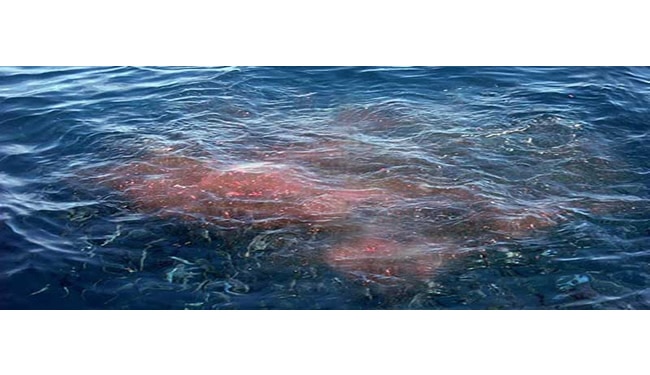
 There are plenty of meanings for chumming or “chum the waters”, but it all depends on the context. The expression may be used to mean “churn the waters” or to make the waters muddy. It also used to indicate that someone got sick on the trip and threw up on the waters. Bird enthusiasts often “chum the waters” by dumping fish to attract seagulls and other sea birds that they, then, try to identify.
Still, in the world of fishing, “chum the waters” or chumming means dumping bait or something into the waters to attract fish. What to dump in the water largely depends on what species you are trying to attract. Though theoretically, any type of bait or fish that you dump into the saltwater will surely attract many fish species – or the fish that you had lured to the chum will attract bigger fish, the ones that you wanted to land. Well, it is often a win-win situation.
What is chumming for sharks?
Chumming simply brings sharks closer that would otherwise not be in the area in proximity to people in the water? Does the chumming alter shark behavior in any significant way? If you are targeting sharks, use a bloody fish. Sharks have a very keen sense of smell so that they could smell blood no matter how diluted it might be.
Unlike the other fish species, sharks aren’t going to congregate on the surface, and spend time cavorting in the same area month after month. Sharks need a little incentive to show up at the boat side. By applying chumming techniques to your fishing arsenal you can lure sharks to your fishing grounds. By tossing the sharks chum, you can keep them in the area for hours. There are certain species of sharks that will readily come to your boat and stay close by. Other sharks like the mako, porbeagle, and thresher a much smarter. They can get lured in and will come very close, but remain at the boat for a few minutes, quickly leaving to get to a safe zone.
What is chumming the water?
There are many different techniques and devices used to be placed in the water. The simplest is throwing it directly into the waters but if you want to make it last longer, you might want to use a perforated bucket attached to a rope that will tug the bucket along as the boat moves. You can also use a mesh bag – and cage, if you are trolling for sharks.
Grinding it up is also a good idea, though you might still want to add in a few pieces of cut fish. So, what does chumming it up mean? It’s when you use dead bait, old fish carcass, and grid or cut it up in many small pieces. Mixed thoroughly, with added fish remains and blood you are ready and go “chum the waters”.
Why is chumming bad?
Each individual situation is different. It depends on the location your chumming? the species you are chumming? and the amount you are chumming? All these can lead to reasons to answer, “why is chumming bad?” or even “when is chumming bad.” Massive amounts in any area are mot good for the environment of the local species. It also provides a high level of aggression to all fish feeding in the area.
Based on the species and location, it can lead to a chain of feeding attacks. Smaller fish feeding on the chum, attract large fish which then feed on them creating a cycle up the food chain until you reach the top which could be sharks. As to how much chumming is bad, it always going to be a decision that needs to be measured locally based on the gathering of information.
Where is chumming illegal?
Where is chumming illegal? Why chumming is legal widely around the world, but in some places, it has become illegal. In the United States, several different states are treating this differently. The state of Alabama is treating it as a danger. Solely based on the pose conditioning it associates with sharks when feeding. And that residents could swim in the same waters. Florida FWC also put forth regulation, but ones that obviously had more thought put into it. Florida also made it illegal when shark fishing, but only when fishing for any species from the beach.
Where is chumming legal?
Chumming is a common practice seen as effective by fishermen all over the world, typically used in ocean waters. Florida looked at all the restrictions for this and decided that it is a safe widely spread used and that based on the science that was no reason to make it illegal. Mainly because many of the areas fished have vast barren sandy bottom structure around Florida. Most of the state views it as a necessity and common practice. The new ruling went into effect on July 1, 2019
Offshore Fishing:
Offshore fishing is the most relevant place to use chum. Chumming the waters can be done in a multitude of ways. Most common, with bags, buckets, or chunking it out there are all excellent ways to attract fish. The use of frozen sardines or your own recipe can be effective. Play around with either and head to your local tackle shop to get all the supplies you need. Local experts come ready to the waters and get you on that fish of a lifetime!

Miami Beach Fishing, Bottom Fishing, Dolphin Fishing, iOutdoors Blog, Kite Fishing, Offshore Fishing, Sail Fishing, Snapper Fishing, Sport Fishing, Sword Fishing, Wreck Fishing
Miami Offshore Fishing Report
Miami, FL is one of the most sought after fishing destinations in the world. You can experience some of the best fishing during the fall season. When you visit Miami, you are opening yourself up for a fishing adventure of a lifetime. Here is a Miami Offshore Fishing Report which consists of some clues to what is going to be biting during these times.
You may be drawn to Florida for beautiful weather, great beaches and exciting night life but don’t count of the exceptional fishing opportunities. If you are planning a vacation from September through November to Miami, you will be visiting during the prime offshore fishing months. Every offshore angler dreams about hunting down some of their favorite catches or to take a fish off their bucket list but you have to know your fish first!
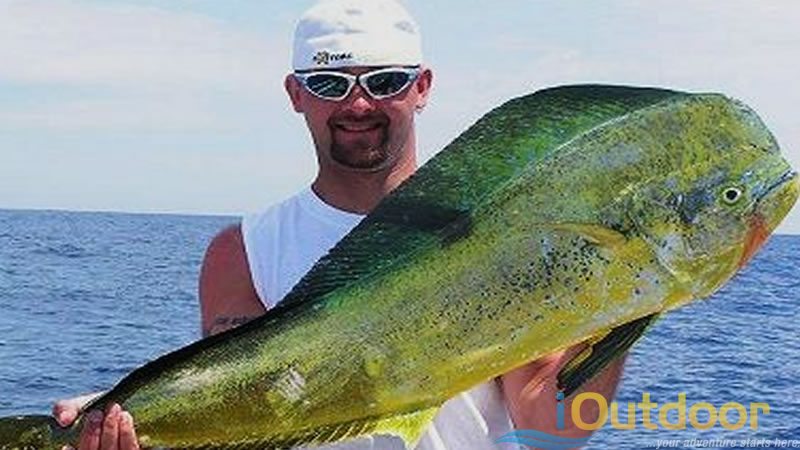 September is a great month to continue to search for that bull dolphin or mahi-mahi. The Gulf Stream is still bringing them through Miami and provides potentials for you to catch great numbers of them. You can also troll some wrecks for king fish during the month of September. Both species enjoy big baits. Stop by your local tackle shop and pick up some ballyhoo. We would also advise to never travel offshore without live bait. You can find schools of pilchards along the beaches or you can also pick up a dozen or two from your local tackle shop. Live bait comes in handy when you come across a large school of fish and want to load the boat quickly. Run out to the largest weed line or structure you can find and hold on for the fight of your life.
October through November bring about the first cold snaps of the year. When this occurs, it will change the way we approach and fish especially offshore. Colder waters and temperatures bring in the sailfish. Live bait is most certainly the most effective method in catching this bill fish. Fly a kite and get ready to have some fun as you watch a sailfish circle your live pilchard or goggle-eye. Get out on the water and determine which depth and location these sailfish are moving in. Keep an eye out for action in shallow depths and jumping sailfish. Don’t count out the king fish from sky-rocketing through the water to chase or eat your live bait.
Swordfish Fishing is also going to be excellent during these months. Whether you want to catch them during the daytime or nighttime is your preference but make sure you know the different techniques in order to do so. Each situation will call for different depths and equipment. Hop on board with a local expert and we can show you how to catch them in either day or night. 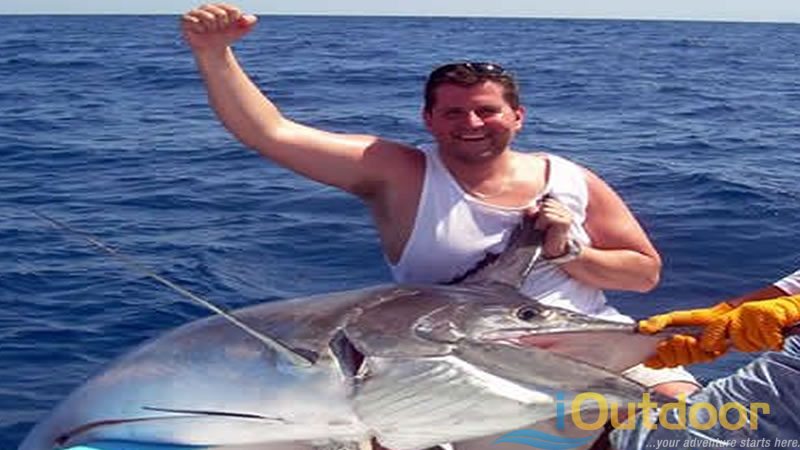
Don’t count out bottom fishing throughout these months. Your local reefs and wrecks will have endless species that you can catch. The main species would be snapper. Not only are they incredible fun to catch but they are most certainly a treat. Snapper is one of the most delicious bottom fish you can catch. Throw out a chicken rig with some deep or live bait and hold on for a great bite.
Your adventure starts when visiting Miami! Offshore fishing is going to be spectacular for an abundance of species. Don’t miss out on the action and take a break from the beaches and enjoy some beautiful weather in the deep blue sea. Feel free to contact us with any questions and we would be glad to help! We can get you in touch with our local experts.
To find out what will be biting during your trip, check out our Miami FL Fishing Calendar!
[fusion_builder_row_inner][fusion_builder_column_inner type=”1_2″ layout=”1_2″ last=”no” min_height=”” hover_type=”none” link=”” border_position=”all”][fusion_button link=”https://ioutdoor.com/fishing/deep-sea/florida/miami/” text_transform=”uppercase” title=”Plan Your Next Outdoor Vacation” target=”_self” link_attributes=”” alignment=”center” modal=”” hide_on_mobile=”small-visibility,medium-visibility,large-visibility” class=”” id=”” color=”blue” button_gradient_top_color=”” button_gradient_bottom_color=”” button_gradient_top_color_hover=”” button_gradient_bottom_color_hover=”” accent_color=”green” accent_hover_color=”” type=”” bevel_color=”” border_width=”3px” size=”small” stretch=”yes” shape=”pill” icon=”fa-ticket-alt fas” icon_position=”left” icon_divider=”no” animation_type=”flash” animation_direction=”left” animation_speed=”0.3″ animation_offset=”top-mid-of-view”]PLAN YOUR NEXT FISHING VACATION[/fusion_button]
Your Adventure Starts Today while Visiting Miami.
Don’t forget to follow us on Facebook, YouTube, Twitter and Instagram.

Destin Fishing, Bottom Fishing, iOutdoors Blog, Offshore Fishing, Triggerfish Fishing, Wreck Fishing
August Destin Offshore Fishing
August is the month and time of year to come to explore what Destin, Florida has to offer. Destin is the ULTIMATE Florida fishing destination with an abundance to offer you. When you are planning your visit to Florida this month, make sure you keep in mind what you can experience on an August Destin offshore fishing charter.
Destin is located along the Emerald Coast of Florida in the Panhandles. Tucked away and hidden from the rest of the state, you can find some of the BEST beaches in Florida. Along with the beautiful scenery, you can also experience some of the most productive offshore fishing especially in the month of August. They aren’t known to be the Luckiest Fishing Village for no reason and iOutdoor can show you what they are all about.
When you are looking for an awesome outdoor activity to substitute your vacation stay on the beach, hop on board one of our offshore fishing vessels. You will have the opportunity to cruise through the Gulf of Mexico to local fishing grounds for large tasty catches. If you love to catch-and-cook while you are traveling and on vacation, this is the perfect opportunity to do so.
August starts one of the best seasons to come fishing in Destin, Florida. Destin Offshore Fishing action picks up strong for Trigger Fish and Amber Jack. Now until October 31st you can catch and harvest an Amberjack. Make sure you check and are familiar with all the FWC rules and regulations before harvesting them. Our local expert offshore fishing captains know all the information you will need in order to have a successful day on the water.
Knowledge is power and leads to success when it comes to offshore fishing. Our professional captains have years of experience catching the offshore species you are after. They will take you out to the closest fishing grounds and best spots in Destin. You can reach highly productive waters within 10 miles of the shore. The best spots are between 4-10 miles.
When you are traveling offshore, make sure you find your sweet zone between 60-90 feet of water. The big amberjacks and triggerfish are holding on the bottom within these depths. Large wrecks, reefs, and barges will produce the best bite. These fish need structure to live and feed. If you are looking for big fish make sure you set up on the largest wreck you can find and throw big baits.
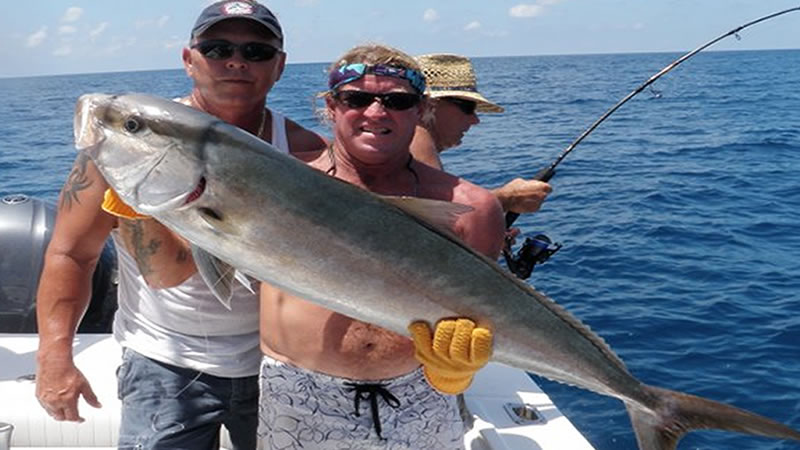
Bottom Fishing in the Gulf of Mexico is the only way to go. It happens to be the best method in catching the Amberjack and Trigger Fish. When in search for a large triggerfish, make sure you throw on some cut bait on a chicken rig and put it on the bottom. This will entice a quick bite, so be ready to reel them in.
Amber jacks are a fun fish to catch. Their size and strength will have you fighting like no other. If you are looking to catch a big Amberjack make sure you put on some big baits. Live bait happens to be the most effective method especially if you use Blue Runners or Pin Fish. Hook them onto a Knocker or Carolina rig and get ready for that fight you have been waiting for.
After reeling in one of these awesome fish, make sure you grab a cold drink to keep yourself hydrated in the summer sun here in Florida. Once your fishing adventure and charter are done make sure you give your captain plenty of time to clean your catch. August Destin Offshore Fishing will provide a thrill worth remembering and repeating again.
Come enjoy a day on the water while reeling in some BIG fish with Captain Wayne Alexander. Amberjacks are some of the strongest fighting saltwater species. Triggerfish and Amberjack both are incredibly delicious fish to cook up and eat. There is nothing like getting off the water and either having a local restaurant cook up your catch.
Don’t miss out on your August Destin Offshore Fishing Charter next time visiting Florida’s Panhandle. You won’t regret a day of fishing or early morning on the water. You can squeeze in a quick trip to the local reef and then hit the beach right after. Let’s get you hooked up and we most certainly look forward to fishing with you next time on the water!!
Your Adventure Starts Today while Visiting Destin.
If you enjoyed this post about Saltwater Fishing, you might also enjoy our Fishing Blogs.
Don’t forget to follow us on Facebook, YouTube, Twitter, and Instagram.
Offshore Fishing, Dolphin Fishing, iOutdoors Blog, Sport Fishing, Wahoo fishing, Water Sports, Wreck Fishing
Port Canaveral Offshore Trolling
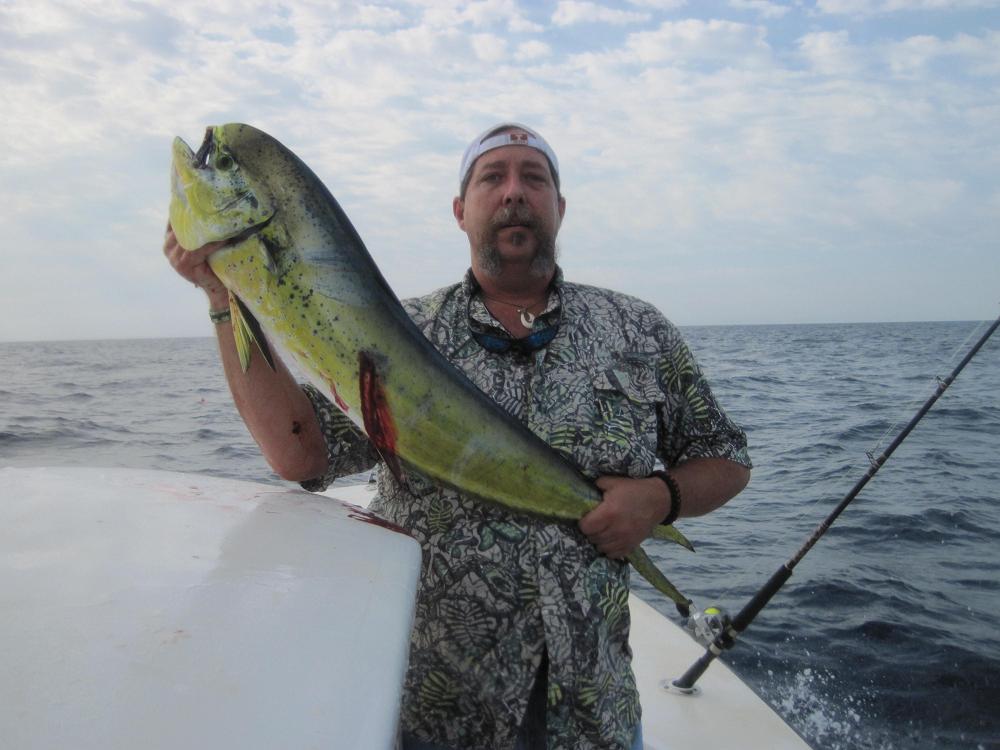
Great weather for fishing. West winds are starting to stack up some weeds offshore, and they proved to be somewhat fishy this trip. NE of the weather buoy some tightly scattered weeds proved to be just what the icebox needed. We started around the perimeter first, and the results came slowly, but good. First fish in was a 15lb Mahi. Like the last few weeks of fishing, these anglers had never caught a “Dolphin”, and made it the target species of the trip. No company with this catch, so lines back to work.
Client David Bunch and his friend were traveling from Oklahoma to adventure out on a Cape Canaveral Offshore Fishing Charter with iOutdoor. They were in-store for an amazing day of fishing with great fish in the boat. You never know what to expect when Port Canaveral Offshore Trolling!

Another half hour and the line goes off again. It did not seem too big till the angler put some bend in the rod, then a couple of hundred yards of line peeled. This fish was not a jumper, but still, we waited till we saw the colors to know what we had. It took a while with our Dolphin rigs to finally work it to the boat, but the Blue stripes was a very welcome sight. Wahoo in the boat. This 50lb fish made the day for these guys, and we still had time to fish.
Another pass around the area with no results, so we decided to cut through the weed field. A little time passed, and a lot of cleaning fouled lines of weed, but another hookup. Another Mahi-Mahi was on the line, dragging weeds with it. As we got it near the boat we saw it had company. The second fish did not take the other lines, so a pitch rod went to work. It looked, it followed, but nada. Other offerings were put in front of it but it turned its nose up at all we offered and eventually made its way off. We sent
lines back out, working the weed field some more with no more action while Port Canaveral Offshore Trolling.
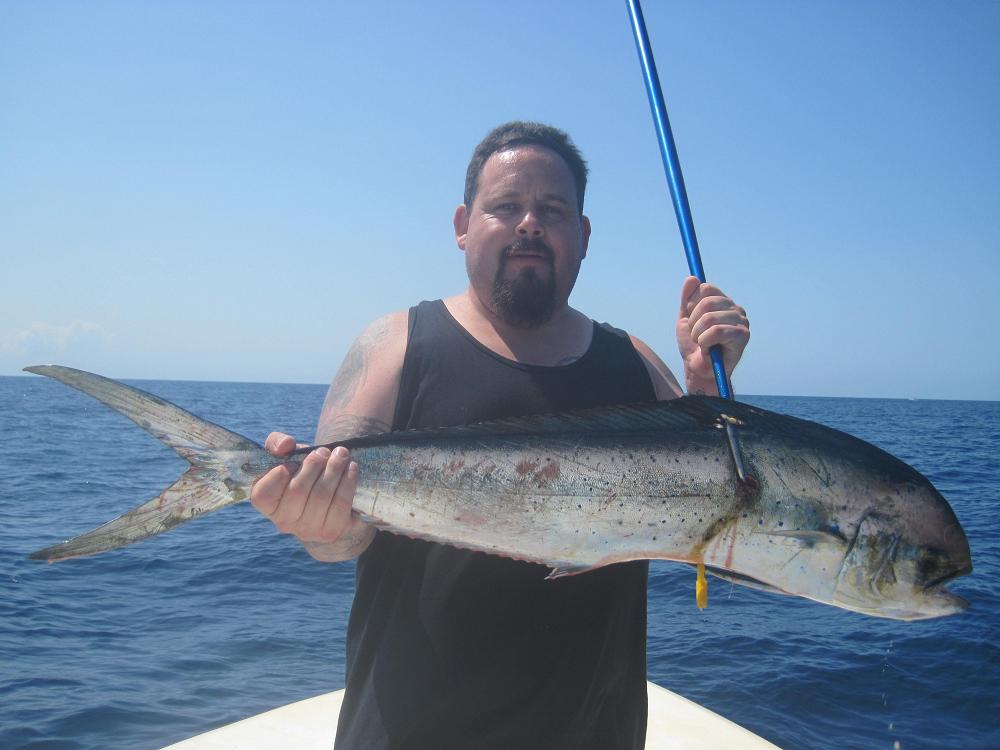
Finally, we headed to 8A to see if we could pick up a King or two to make a Slam. One line down, another out the back, and into slow gear we went. 20 minutes into the run, the downrigger released, and drag went out. This fish came to the surface and went airborne. A nice 20 lb bull Mahi was on the line. We worked it to the boat, and about a foot short of gaff range it decided it no longer wanted to play the game and unhooked itself. Big smiles were on the anglers faces despite the loss of this fish. With lobster red sunburnt skin, they were ready to return to port and clean fish.
Your Adventure Starts Today while Visiting Florida.
If you enjoyed this post about Saltwater Fishing, you might also enjoy our Fishing Blogs.
Don’t forget to follow us on Facebook, YouTube, Twitter and Instagram.

Water Sports, Charter Head Boat, Inshore Fishing, iOutdoors Blog, Key West Fishing, Miami Beach Fishing, Offshore Fishing, Party Boat Fishing, Sport Fishing, Wreck Fishing
SAFETY AT SEA AND YOUR CHARTER.
Charter Boat laws:
Operating a Charter Fishing operation requires more than just a captain and a boat. The Captain must hold a current USCG license with homeland security TWIC card. To be a saltwater Fishing Guide in Florida, you must also comply with U.S. Coast Guard (USCG) requirements. The U.S. Coast Guard (USGC) requires all operators of for-hire vessels to have a Captain license. Charter vessels must also be commercially registered. Charter, headboat and saltwater fishing guide operations must have an FWC charter captain or boat license to cover their passengers, who are not required to hold a recreational saltwater fishing license.
This license allows the captain and vessel to engage in charter fishing, whale watching, SCUBA diving, and tour cruises. This license is limited to near coastal waters only not more than 100 miles offshore and is not valid for international voyages. He must be enrolled in a random drug testing program, and carry a current first aid card. The boat must meet USCG – UPV standards (for 6 or less guest). There are many additional safety items required on a charter boat than a recreational boat. Trash and pollution place-cards are required onboard, as well as an emergency plan. Coast Pilot, Tide Charts and Light List for the waters operated are required onboard. Type 1 PFD’s with a whistle, lightened reflective tape are required for everyone on board. A life-ring is also required. This and the PFD’s are required to include either the boats name or registration numbers. Though inspections are not required, it is best if it is done to ensure compliance.
A state fishing license must be provided for all guest fishing on the boat. Federal (NOAA) Fishing Permits are required if the boat will engage in any fishing activity past state lines (3 miles Atlantic – 9 miles Gulf). Although VHF’s nor GPS locators are not required, they should be considered as a very important safety equipment that should be on every boat. Properly licensed Captains and charter operations spend a good deal of money to be so, and will not mind showing these required licenses and permits. If a charter operator will not show you these, then it may be best to look elsewhere.
Always make sure your boat and captain has these safety items on board:
-
- Working radio.
- A correctly fitting life preserver for each passenger.
- Signaling devices both visual and audible such as flairs, whistle and/or hand held air horn.
- Anchor.
- Some type of shade.
- Plenty of fresh water.
- Fire extinguisher.
- A throw-able flotation device.
- First aid kit.
You can do your part by:
-
- Wearing proper clothing for a day out in the elements.
- Using alcoholic beverages moderately.
- Following the instructions of the captain, guide or mate.
- Getting plenty of sleep the night before and staying hydrated.
- Wear sunscreen and a hat. The Florida sun can be brutal.
- Proper shoes that protect your feet and boat deck.
- A life jacket is no substitute for adult supervision of children in and around the water. Children float differently than adults. Because their body weight is distributed differently, children are more likely to float face down in the water.
If you are not sure the boat you are chartering has the necessary equipment ask your captain or guide to show you. If he does not or cannot comply think twice about continuing your charter. Your safety is your ultimately your responsibility, don’t leave it up to the other guy, insist on good boating safety practices!

Fly Fishing, Backcountry Fishing, Bottom Fishing, Destin Fishing, Dolphin Fishing, Drift Fishing, Flats Fishing, Grouper Fishing, Inshore Fishing, iOutdoors Blog, Islamorada Fishing, Key West Fishing, Kite Fishing, Lobster Catching, Marlin Fishing, Miami Beach Fishing, Offshore Fishing, Permit Fishing, Redfish Fishing, Sail Fishing, Shark Fishing, Snapper Fishing, Snook Fishing, Sport Fishing, Sword Fishing, Tarpon Fishing, Trout Fishing, Tuna Fishing, Wahoo fishing, Wreck Fishing
What hook should you use for which fish?
Wow! Old as man itself but it can really be overwhelming when you start to choose a hook. Freshwater, saltwater, bait hooks,“J” hook, circle hook or live bait hooks. Hook choice is VERY important! As a general rule I judge the hook size I need to use as a function of the bait size I am using, not the size of the fish I am targeting. The fish I am targeting determines the bait size. I particularly prefer circle hooks- they virtually hook themselves and are very fish friendly in catch and release situations. Experience is the best teacher on hook selection- use the right hook for the right fish and type of fishing you are doing and be prepared have a selection of hooks at hand. One common mistake is using a hook that is to big. Imagine this – if I hook you in the arm with a small quarter size hook are you going to be able to get a way or are you going to follow me anywhere? A sharp point and a strong hook is much more important than the size. Except in the case of top water lures please consider twice before you use a treble hook- there is virtually no opportunity for catch and release using a treble hook and they are banned in many areas. Treble hooks are dangerous to fisherman as well- use them sparingly and only when you plan to kill and eat the fish. One very important rule: Even though a new hook seems sharp out of the package always, always sharpen your hooks before you use them and re-sharpen them often.
Fish hooks come in several types. Knowing a few of the more popular ones and their uses can help you be successful.
Which hook should you use for which fish?
 O’SHAUGHNESSY This hook is named for the specific design of the hook. It’s a standard hook, forged with a very strong bend. This hook is relatively thick, very strong, and not likely to bend out of shape. Generally designed for saltwater, it is good for general bottom fishing use. Sizes range from #3 to as large as 19/0.
 ABERDEEN These hooks, while primarily used in smaller sizes in freshwater, are also used by saltwater anglers. They are generally made from shaped wire. Unlike the O’Shaughnessy, it can and does bend. It can be bent back into shape several times before it becomes too weak. However, once a fish is hook and the barb has completely penetrated, this hook holds quite well. These hooks are modified with bends in their shanks for use in jig molds.
 CIRCLE Perhaps the best innovation in hooks to come along, circle hooks promote healthy catch and release. The design of the hook itself, when used properly, prevents fish from being hooked in the gut. Many anglers have a problem using these hooks because they require no hook set. If you do try to set the hook, it will generally come out of the mouth of the fish. These hooks are designed to move to the corner of the fish’s mouth and set themselves as the fish swims away from you. Anglers feel a bite and simply begin reeling, slowly at first, then faster as the hook gets set.
 LIVE BAIT These hooks generally have a shorter shank than other hooks. Whether that is to allow the live bait to swim more freely or to be less apparent to the fish is debatable. My vote is to allow the bait to swim more freely. These hooks come in regular and circle designs. Regular live bait hooks will be swallowed and result in gut hooks most of the time. Circle live bait hooks provide a greater chance for a good release.
 KAHLE The curve on these hooks makes them ideal for live bait. Made from the same wire as the Aberdeen hooks, they will bend if hung on the bottom of some structure. However, once a fish is hooked, the design of the hook prevents it from being straightened.
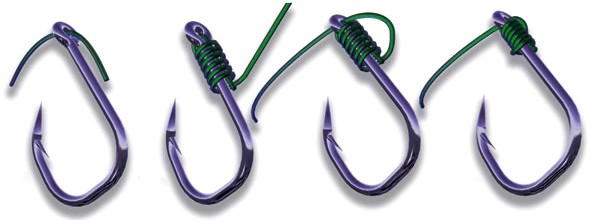
The Guide below provides an overview of the parts of a fishing hook. There are some common parts to all hooks. Those parts include the eye, shank, gap, point and barb. The variations on these characteristics result in dozens of hook styles.
Anatomy of a Hook
The Eye
The hook eye is the connection point to the fishing line or the body of lures. Ringed eyes are the most common. The metal is bent in a uniform loop and the end sits flush against the shank. Needle, looped and tapered are some other types of hook eyes, but they tend to be used for specific applications, like saltwater or dry flies.
The Shank
The shank is the length of the hook from the eye to where the bend starts. Shanks come in short, medium or long lengths. Short ones greatly reduce the size of the hook. Medium length shanks are the most common and used in an array of fishing situations. Long shanks can be used for live bait fishing where finesse isn’t critical, or to match a longer profile of an artificial bait.
The Gap
The gap is the size of the bend in a hook from the shank to its point. An average size gap will do in most situations, but sometimes a wide gap is needed. A wide gap is used for rigging thick-bodied baits to ensure that the hook point will be exposed on the hook set.
The Point
This is the tapered end of the hook. As its name suggests, it’s the sharp point that penetrates a fish’s mouth. The shape of the point will vary. Needle, knife edge, spear, or rolled ones are some examples. The most important thing, however, is that you keep your points sharp, so invest in a hook file and use it often. Quality hooks are packaged extremely sharp and will stay sharp longer than cheaper ones.
The Barb
The barb is designed to hold the hook in place once it penetrates the fish’s mouth. The larger the barb, the more difficult it is for the fish (and likely yourself) to get the hook free. Many catch and release anglers pinch barbs with pliers or file them down for easy hook removal.
Other Basic Hooks
 BAIT HOOKS come in a variety of styles. Most feature barbs on the shaft to hold bait in place. Longer shank hooks are good for teaching kids to fish, while shorter shank ones are often used in snells.
 TREBLE HOOKS feature three bends and points in one hook. Trebles provide more hooking potential to many artificial baits such as crankbaits, jerkbaits or topwaters. Bait anglers also use trebles. Cut bait for catfish or threading minnows for lake trout are two examples where trebles are regularly used.
 SIWASH HOOKS are quite strong and have a long shank and point. These hooks have a straight eye so they sit properly on lures. Siwash hooks are often used on single-hook baits, such as spinnerbaits. I also use them sometimes to replace factory-provided treble hooks on certain baits, especially spoons.

JIG HOOKS are designed to sit in specific jig molds. They feature a bend just below the hook eye, with a 90-degree bend being the most common. Pouring your own jigs can save you money and be a fun winter hobby to gear up for the next season

 There are plenty of meanings for chumming or “chum the waters”, but it all depends on the context. The expression may be used to mean “churn the waters” or to make the waters muddy. It also used to indicate that someone got sick on the trip and threw up on the waters. Bird enthusiasts often “chum the waters” by dumping fish to attract seagulls and other sea birds that they, then, try to identify.


 Long shanks can be used for live bait fishing where finesse isn’t critical, or to match a longer profile of an artificial bait.


